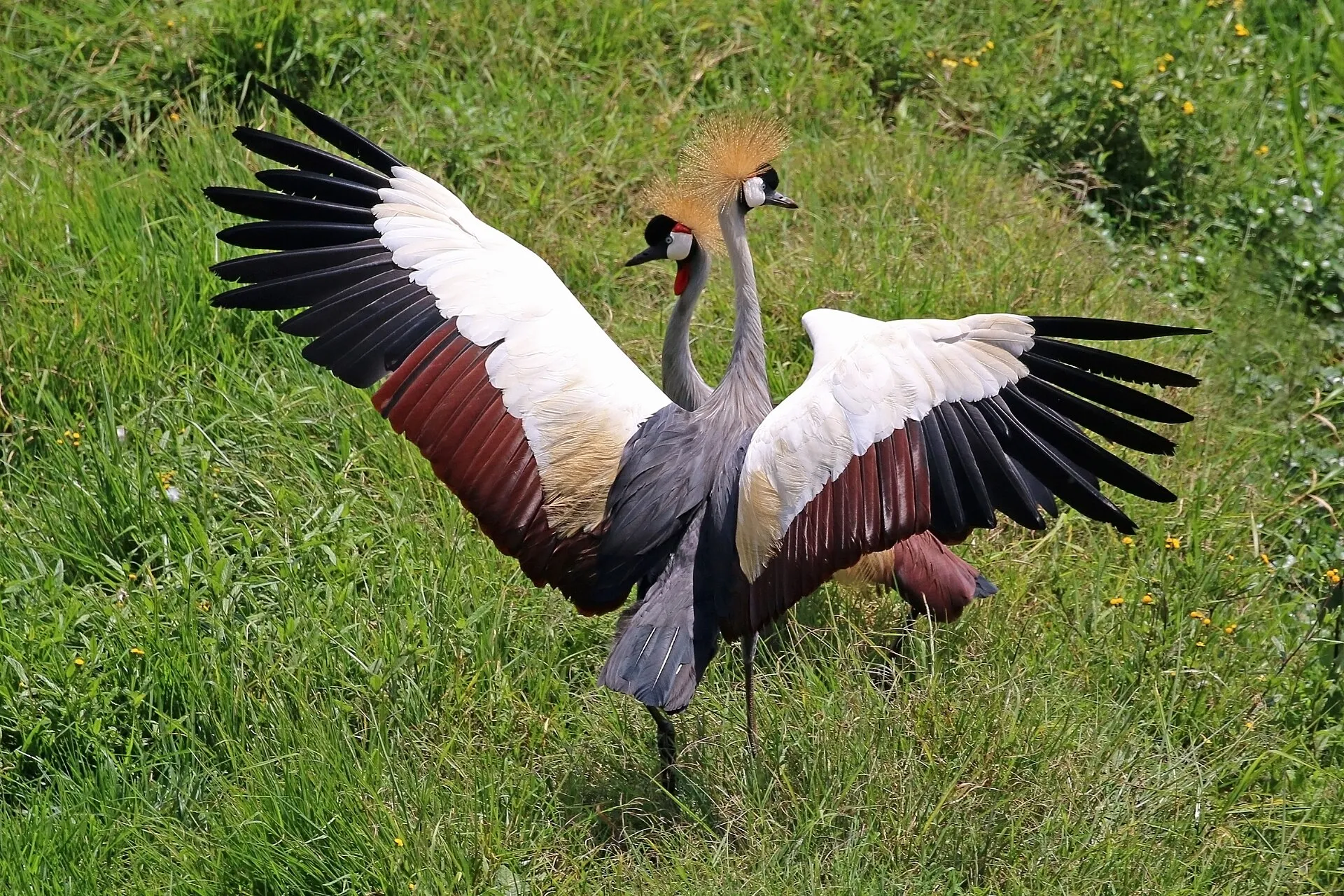
The grey crowned crane is Uganda’s national bird and appears on the national flag. It is listed as endangered, and Uganda’s population has fallen from about 100,000 four decades ago to an estimated 10,000–20,000 today, mainly due to wetland loss. It can be seen at Lake Mburo, Queen Elizabeth, Mabamba, wetlands in south-western Uganda and in farmland near swamps.
Key takeaways
- Uganda’s national bird, on the national flag.
- Listed as endangered.
- Famous for its dancing displays.
- Seen in wetlands and grasslands.
The grey crowned crane is a tall bird with grey plumage, white and gold wings, a bright red throat pouch and a crown of stiff golden feathers. It is one of only two crane species that roost in trees.
The dance
Cranes dance to strengthen pair bonds and during courtship. Pairs bow, leap into the air with wings spread, and call with loud honking. Watching a dancing pair is one of the most memorable sights of a Uganda safari.
Why it is endangered
- Wetlands are drained for farming.
- Eggs and chicks are taken for the illegal trade.
- Cranes are injured by power lines and poisoned crops.
Conservation groups work with communities to protect breeding wetlands.
Where to see it
- Lake Mburo and the grasslands around it.
- Queen Elizabeth National Park, on the Kasenyi plains.
- Mabamba Swamp and wetlands in south-western Uganda.
- Kenya and Tanzania, including the Masai Mara and Ngorongoro.
When to go
Cranes can be seen year-round. Breeding often follows the rains, when pairs are more likely to dance.
Good to know
- Keep a respectful distance; nesting cranes are sensitive.
- Binoculars help in wetland edges.
- Ask your guide about local conservation projects.
- Cranes often feed near farms; look for them on drives.
Who it suits
Cranes suit everyone, from birders to families. They are a symbol of Uganda, and seeing one is a lovely way to connect with the country.
Uganda’s symbol
The crane appears on the Ugandan flag and coat of arms. It was chosen for its elegance and gentle nature, and it was a symbol of the colonial-era Uganda Protectorate before independence in 1962.
How you can help
- Choose lodges and guides that support wetland conservation.
- Never buy cranes or crane products; captive cranes are often taken from the wild.
- Report captive cranes to conservation groups.
- Visit community wetland projects, such as the Bigodi Wetland Sanctuary.
Black or grey?
The black crowned crane, found mainly in West Africa and Sudan, is similar but darker, with a black neck. The grey crowned crane is the species of East and southern Africa, and the one you see in Uganda, Kenya and Tanzania.
Breeding
Grey crowned cranes nest in wetlands, building a platform of grass and sedges in shallow water. They lay two to three eggs, and both parents care for the chicks. Pairs often stay together for life.
Where to stay
For Lake Mburo, stay in or near the park. For Queen Elizabeth, stay on the Mweya Peninsula or near Kasenyi.
Photography tips
Cranes are wary, so a long lens is useful. Look for them feeding in grassland in the early morning, or flying in pairs at sunset.
Cranes and culture
In Uganda, cranes are admired for their beauty and grace, and appear on the national flag and coat of arms. In some communities, cranes are protected by tradition.
Who it suits
Everyone, especially birders, photographers and families.
Wetlands and cranes
Grey crowned cranes need wetlands to nest, and grasslands and farms to feed. In Uganda, many wetlands have been drained for farming and settlement, reducing safe nesting sites. Cranes also suffer when eggs and chicks are taken for sale as pets, a practice that is illegal. Conservation groups work with farmers to protect nesting wetlands, rescue captive cranes, and educate communities about the importance of the national bird. Visitors can help by choosing guides and lodges that support wetland conservation, and by never buying captive cranes or crane products anywhere they travel.
Cranes across Africa
Grey crowned cranes live in East and southern Africa, from Uganda and Kenya to South Africa. They are seen in the Masai Mara, the Ngorongoro Crater, Akagera and many wetlands. In every country, wetland loss is the main threat, so protecting swamps and marshes is the key to their survival.
Plan it
See cranes on our 2-day Lake Mburo safari or 7-day Uganda birding safari.
Frequently asked questions
Why is the crane on Uganda’s flag?
It is the national bird, chosen for its beauty and gentle character.
Is the grey crowned crane endangered?
Yes. It is listed as endangered by the IUCN.
Where can I see cranes dancing?
In wetlands and grasslands, often around the rains.
How tall is a crowned crane?
About 1 metre.
How many grey crowned cranes are left in Uganda?
Estimates suggest between 10,000 and 20,000, down from about 100,000 four decades ago.
Can I see cranes dancing?
Sometimes, especially around the rains when pairs court in wetlands and grasslands.

Written by our Kampala-based planners and guides, who arrange these trips every season. Prices and rules are checked before every quote.


