Key takeaways
- Not a true stork: its closest relatives are pelicans and the hamerkop.
- It hunts lungfish by standing still, then lunging forward in a move called the collapse.
- Resident all year in Uganda; early morning is best.
- Mabamba is the most accessible site; the Murchison delta is a good second.
- Community canoe fees help protect the wetland.
Meet the Shoebill
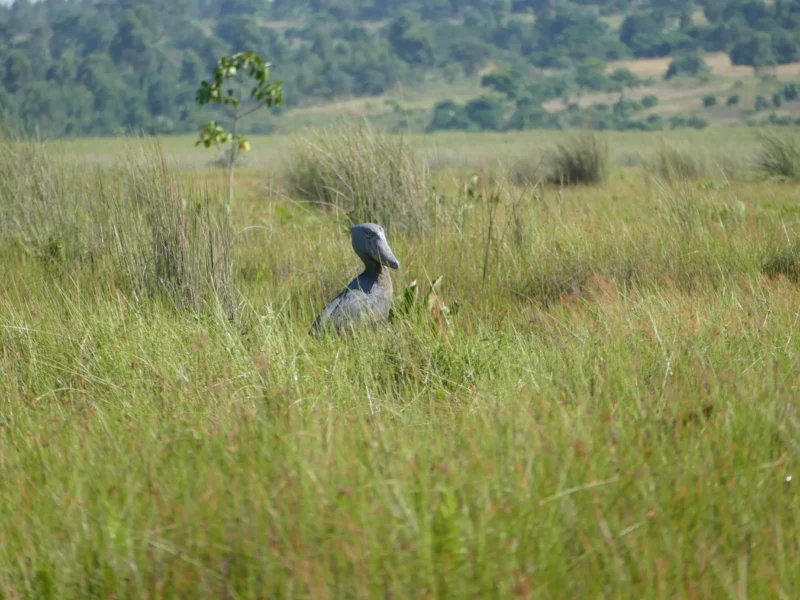
The Shoebill (Balaeniceps rex) is a large, grey wading bird of central and eastern Africa’s swamps, and the single bird most visiting birders want to see in Uganda. It stands roughly 110 to 140 centimetres tall, has a wingspan of about 2.3 to 2.6 metres, and carries an enormous bill shaped like a wooden clog, with a sharp hook at the tip. Pale yellow eyes and a habit of staring straight back at you give it a famously prehistoric look.
Despite the old name “shoe-billed stork”, it is not a true stork. Genetic studies place it closest to pelicans and the hamerkop, and it is the only living member of its family, Balaenicipitidae.
Shoebill facts at a glance
| Scientific name | Balaeniceps rex |
|---|---|
| Height | About 110–140 cm |
| Wingspan | About 2.3–2.6 m |
| Weight | Roughly 4–7 kg; males are larger |
| Diet | Mainly lungfish, also catfish, tilapia, frogs and water snakes |
| Habitat | Permanent papyrus swamps and floodplains with floating vegetation |
| Range | South Sudan, Uganda, Zambia, Tanzania, DR Congo, Rwanda and neighbouring countries |
| Conservation status | Vulnerable (IUCN Red List) |
Behaviour: patience, then a lunge
The Shoebill is an ambush hunter. It stands on floating vegetation or in shallow water, sometimes motionless for many minutes, watching for fish that come up to breathe in oxygen-poor water. Lungfish are a favourite because they must surface regularly. When it strikes, the bird pitches its whole body forward and down in a move birders call the collapse, then rises with fish, weed and water in its bill, shaking out everything except the meal.
Other behaviour worth watching for:
- Bill-clattering, a loud, rattling greeting used at the nest.
- Bowing between pairs, part of their nest-site displays.
- Soaring: despite their size, Shoebills fly well and occasionally circle on thermals.
- Solitude: outside breeding they are usually alone, often well spaced across a swamp.

Breeding and conservation
Shoebills nest on floating mounds of vegetation deep in the swamp, laying one to three eggs. Usually only one chick survives to fledge, which makes the species slow to recover from losses. Adults are long-lived, and pairs defend large territories.
The population is estimated in the low thousands and is declining. The main threats are drainage and burning of wetlands for farming, disturbance, and the illegal capture of chicks for the wildlife trade. In Uganda, community-run sites such as Mabamba Bay, a Ramsar-listed wetland on Lake Victoria, show how tourism can help: canoe fees and local guide jobs give fishing communities a reason to protect the birds rather than disturb them.
Where to see a Shoebill in Uganda
Mabamba Swamp, near Entebbe
The most accessible Shoebill site in Africa. Mabamba lies on the northern shore of Lake Victoria, about 45 minutes from Entebbe by road. You explore the channels by wooden dugout canoe with a local poler and guide, which means you can approach quietly through the papyrus. Our 1-Day Mabamba Shoebill Day Trip (from US$250) and both our 4-day and 8-day safaris start here.
The Murchison Falls delta
A boat trip downstream from Paraa to where the Victoria Nile enters Lake Albert passes papyrus edges where Shoebills hunt. It combines well with game drives and the launch trip to the falls.
Other sites
Shoebills are also recorded around Lake Mburo, in the Semliki lowlands and in swamps around Lake Kyoga. Outside Uganda, Akagera National Park in Rwanda has occasional sightings, while Zambia’s Bangweulu Swamps and South Sudan’s Sudd hold larger, harder-to-reach populations.
Tips for seeing and photographing one
- Go early. The first hours after sunrise are best for activity and soft light. Our Mabamba pickups are at 5–5:30am.
- Trust the poler. Local guides know which channels the birds are using this week; water levels shift with the seasons.
- Bring a long lens (300 mm or more) and binoculars, as canoes keep a respectful distance.
- Stay still when the canoe stops. Sudden movement rocks the boat and flushes birds.
- Pack a rain jacket and a hat. Mornings on the lake can be cool, and the sun is fierce by 10am.
- Be patient. Sightings are frequent but never guaranteed, and the best moments often come after a long wait.
Read what a morning at Mabamba is really like.
How to tell a Shoebill from other big wetland birds
- Marabou Stork: also huge and grey, but with a bare pink head, a long pointed bill and a dangling throat pouch. Common around towns and rubbish tips, not hidden in papyrus.
- Saddle-billed Stork: black and white with a red-and-black bill topped by a yellow “saddle”. Elegant rather than bulky.
- Goliath Heron: the largest heron, chestnut and grey, with a long, slim, dagger-like bill.
- Shoebill: uniformly blue-grey, with a massive, broad, clog-shaped bill and a slightly shaggy crest at the back of the head. It stands very upright and very still.
Best time of year
Shoebills are resident in Uganda all year, so there is no wrong month. What changes is the water. In wetter months, higher water opens more channels and birds can be spread more widely; in drier months, they may concentrate around remaining deeper pools. Local polers follow these shifts week by week. From November to March, European migrant birds add extra variety to a morning in the swamp.
Watching Shoebills responsibly
- Keep the distance your guide sets, and never ask a poler to push into a bird’s feeding area.
- No playback of calls, no drones and no flash.
- If a bird changes its behaviour (stops feeding, walks away or takes flight), you are too close.
- Pay the community fees and use local guides. That income is what protects these wetlands.
Frequently asked questions
Is the Shoebill a stork?
No. Despite the old name “shoe-billed stork”, genetic studies place it closer to pelicans and the hamerkop. It is the only species in its family.
How tall is a Shoebill?
Roughly 110–140 cm, with a wingspan of about 2.3–2.6 metres.
What is the best place to see a Shoebill?
Mabamba Swamp near Entebbe is the most accessible site, explored by canoe in a morning. The Murchison Falls delta is a good second option.
Are Shoebills endangered?
They are listed as Vulnerable by the IUCN, with a declining population estimated in the low thousands.
Can I see a Shoebill on a day trip?
Yes. Our 1-Day Mabamba trip from Entebbe or Kampala costs from US$250 and returns you by early afternoon.

Written by our Kampala-based planners and guides, who arrange these trips every season. Prices and rules are checked before every quote.