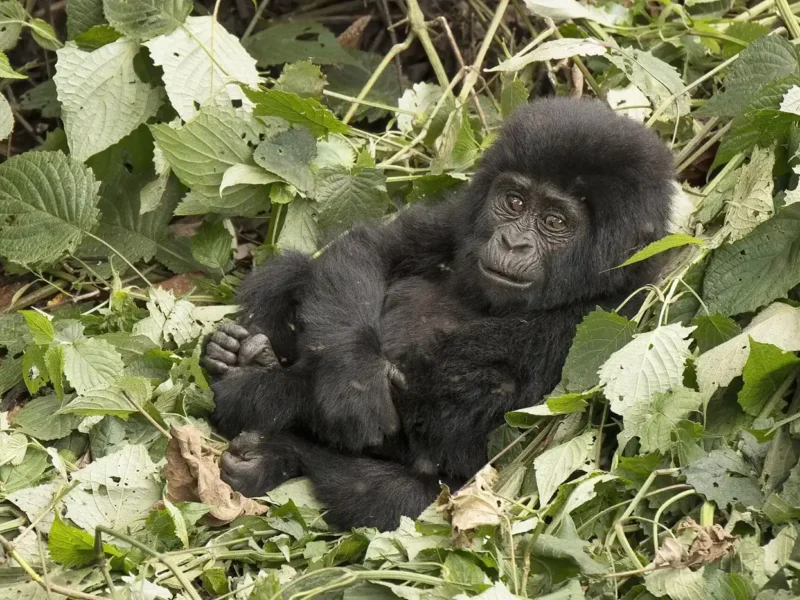
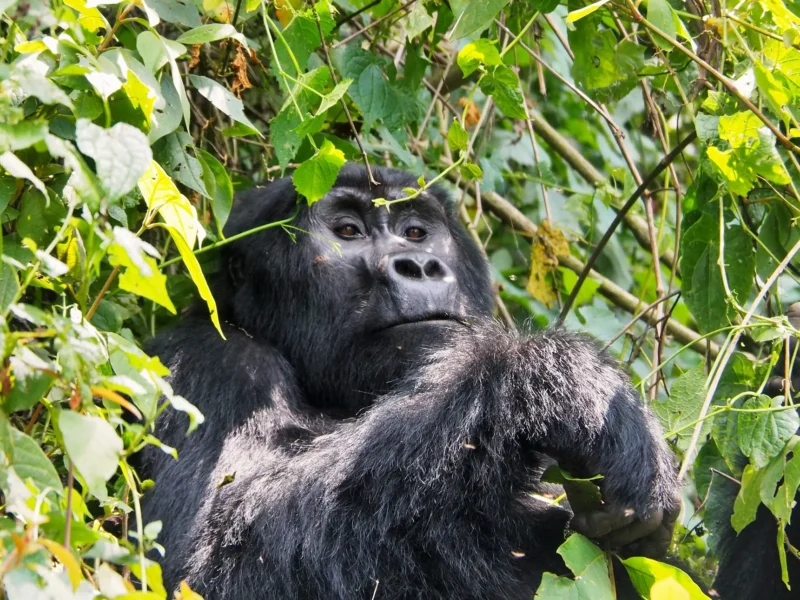
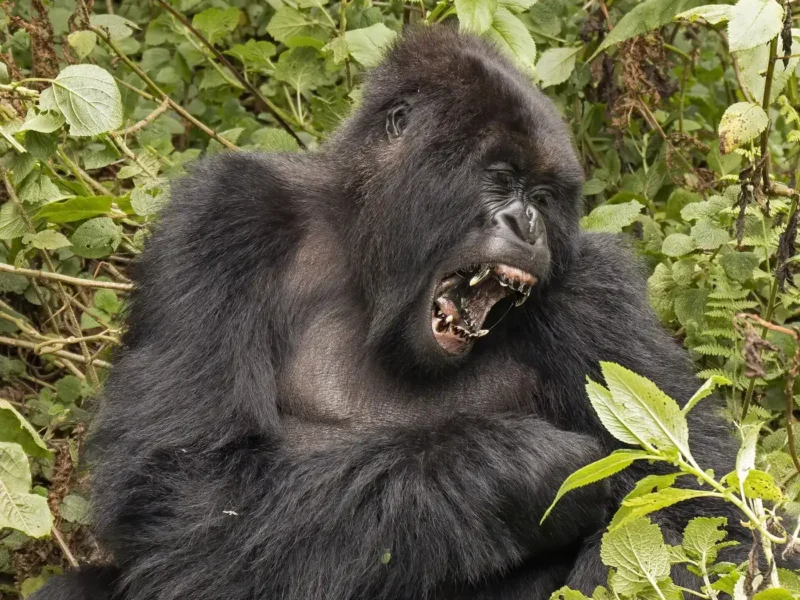
The mountain gorilla (Gorilla beringei beringei) lives only in two forest blocks: Bwindi Impenetrable National Park in Uganda and the Virunga volcanoes shared by Uganda, Rwanda and Congo. The last full census counted 1,063 individuals, up from about 620 in 1989, and the IUCN downgraded the subspecies from Critically Endangered to Endangered in 2018. Visitors can spend one hour with habituated families with a permit.
Key takeaways
- Only about 1,063 mountain gorillas exist, in Bwindi and the Virungas.
- They live in family groups led by a dominant silverback male.
- Their diet is mostly leaves, stems, pith and shoots; they rarely drink.
- Numbers have grown thanks to protection, veterinary care and tourism revenue.
- You can visit habituated families in Uganda (US$800 permit) or Rwanda (US$1,500).
Few wildlife encounters compare with sitting in the forest a few metres from a family of mountain gorillas. Infants tumble over each other, mothers groom their young and the silverback watches calmly over everyone. These are some of the most closely protected animals on earth, and their recovery is one of conservation’s great success stories.
Where mountain gorillas live
Mountain gorillas live in just two populations, separated by about 30 kilometres of farmland:
- The Virunga Massif, a chain of volcanoes shared by Rwanda’s Volcanoes National Park, Uganda’s Mgahinga Gorilla National Park and Congo’s Virunga National Park.
- Bwindi Impenetrable National Park in south-west Uganda and the neighbouring Sarambwe reserve in Congo. Read our Bwindi guide.
They live between about 1,400 and 3,800 metres above sea level, in montane forest, bamboo and sub-alpine vegetation, where nights are cold and rain is frequent. Their long, thick fur helps them cope.
Family life
Mountain gorillas live in stable groups, usually of 5–30 individuals, led by a dominant adult male called a silverback after the grey saddle of hair that develops on his back from about 12 years of age. Some groups have more than one silverback. The group typically includes several adult females, their offspring and younger males (blackbacks).
The silverback decides where the group travels, feeds and nests, and he protects it from rival males. Females usually give birth to a single infant after a pregnancy of about eight and a half months, and births are spaced about four years apart, which is one reason populations grow slowly. Infants ride on their mothers’ backs and stay close to them for several years.
Each evening, every gorilla except young infants builds a new nest of folded vegetation, on the ground or in low trees, to sleep in.
What they eat
Mountain gorillas are mainly vegetarian. They eat leaves, stems, pith, shoots and roots of more than 100 plant species, including wild celery, thistles, nettles and bamboo shoots in season, with some fruit, bark and insects. An adult male can eat around 30 kg of vegetation a day. They get almost all the water they need from their food and rarely drink.
A conservation success story
By the early 1980s mountain gorilla numbers had fallen to around 250 in the Virungas, threatened by poaching, habitat loss and war. Today the total is over 1,000, thanks to:
- Strict protection by rangers in all three countries.
- Veterinary care by the Gorilla Doctors, who treat snare wounds and illnesses.
- Research and monitoring, begun by Dian Fossey at the Karisoke Research Center in 1967.
- Tourism revenue, as gorilla permits fund parks and a share goes to communities around them.
In 2018 the IUCN downgraded the mountain gorilla from Critically Endangered to Endangered, a rare improvement for a great ape. Threats remain, including snares set for other animals, human diseases and the limited size of their forests. Read more in our gorilla permit guide.
How to see mountain gorillas
The only way to see mountain gorillas in the wild is on a guided trek with a permit:
| Country | Park | Permit (2026) | Notes |
|---|---|---|---|
| Uganda | Bwindi, Mgahinga | US$800 (US$600 Apr, May, Nov) | Most families; habituation experience available |
| Rwanda | Volcanoes NP | US$1,500 | Closest to an international airport |
Each family can be visited by a maximum of eight people a day, for one hour, keeping at least 10 metres away. Treks take from one to six hours. For a full walk-through, read our gorilla trekking guide, and for a longer visit see the gorilla habituation experience.
If a gorilla approaches you, stay still, look down and let it pass. Rangers will guide you, and calm behaviour keeps both you and the gorillas safe.
Gorillas and people
Mountain gorillas share about 98% of their DNA with humans and are vulnerable to human illnesses such as colds and flu. That is why visitors with a cold are asked not to trek, why masks are worn near the gorillas and why visits are limited to one hour.
Best time to see mountain gorillas
Gorillas can be visited every day of the year. The drier months, June to September and December to February, make trails firmer and photography easier. April, May and November are wetter but bring Uganda’s US$600 low-season permit and quieter forests.
Frequently asked questions
How many mountain gorillas are left?
The last full census counted 1,063: 459 in the Bwindi-Sarambwe ecosystem and 604 in the Virunga Massif. A new census is under way and is expected to show further growth.
Are mountain gorillas dangerous?
Habituated gorillas are calm and used to people. Silverbacks may display or mock-charge if they feel threatened, which is why rangers brief visitors to stay quiet, keep 10 metres away and follow instructions.
How big is a silverback?
Adult males weigh around 150–200 kg and can stand about 1.7 metres tall on two legs. Females are roughly half the size.
What is the difference between mountain and lowland gorillas?
Mountain gorillas have longer, thicker fur for cold, high-altitude forests, larger jaws and are a subspecies of the eastern gorilla. Western lowland gorillas live in the lowland forests of central-west Africa.
Can children see mountain gorillas?
Gorilla trekking has a minimum age of 15 in both Uganda and Rwanda.

Written by our Kampala-based planners and guides, who arrange these trips every season. Prices and rules are checked before every quote.