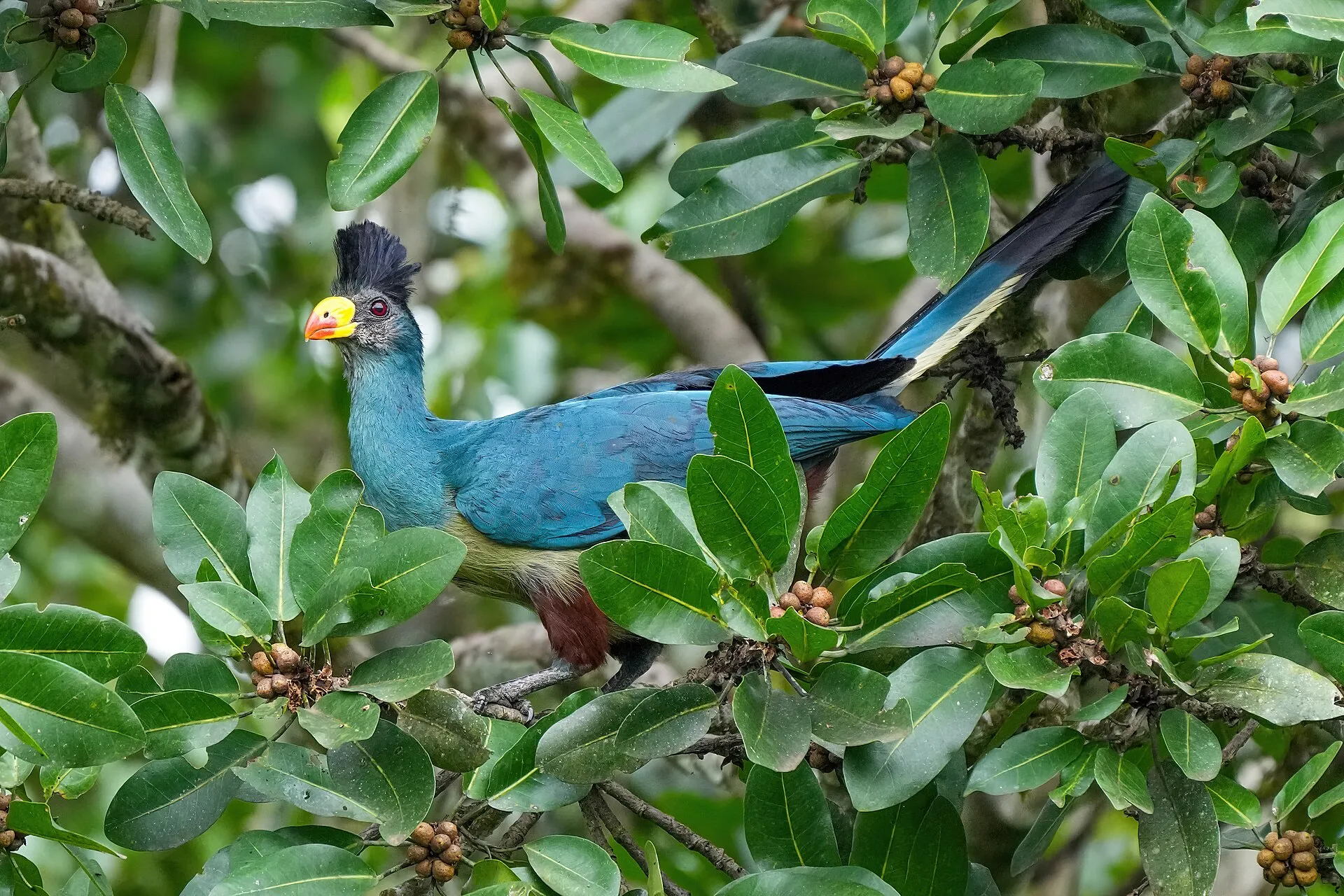
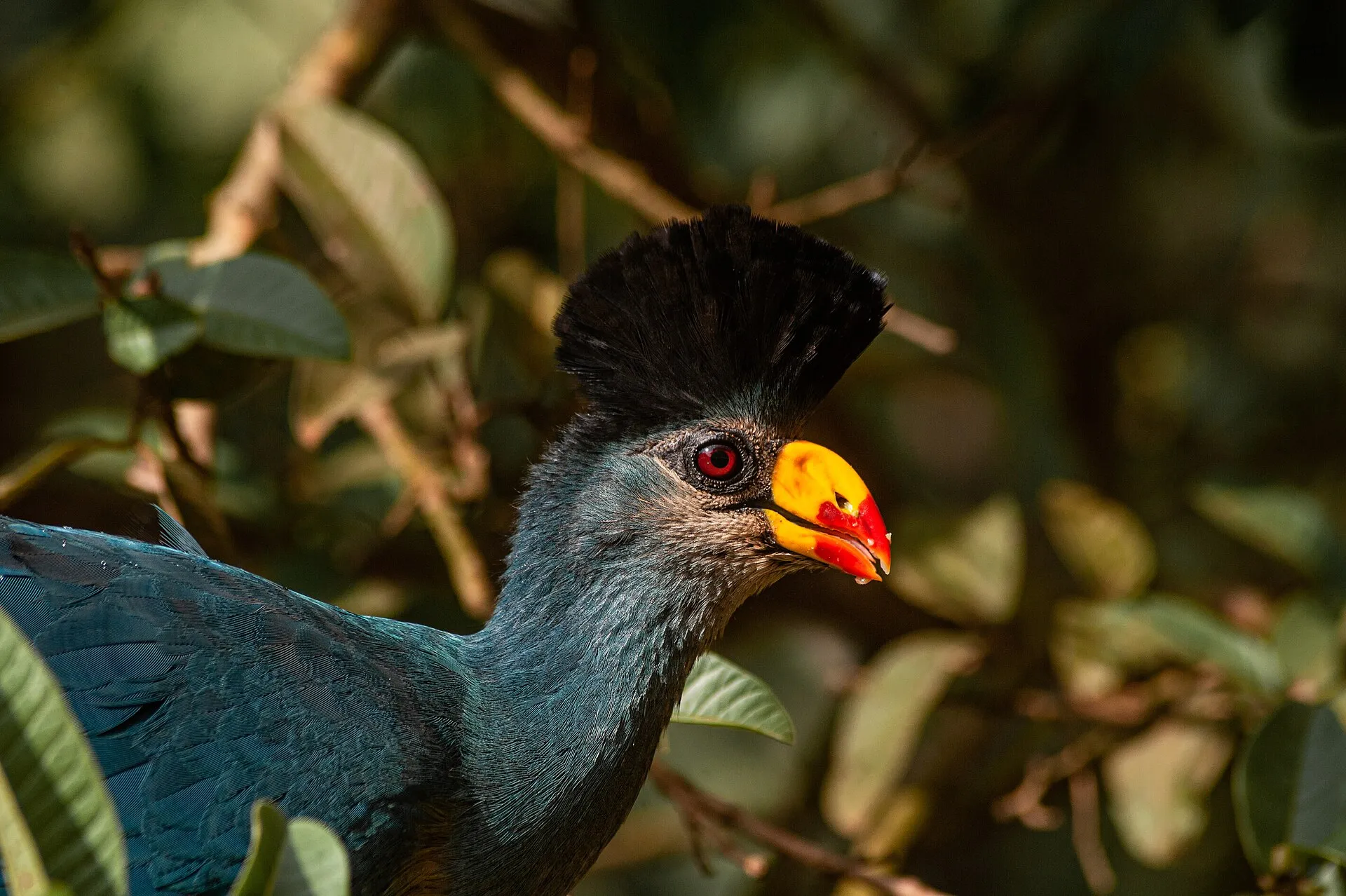
The great blue turaco (Corythaeola cristata) is the largest turaco, about 70–75 cm long, with turquoise-blue upperparts, a yellow-green belly, a black crest and a yellow and red bill. It lives in groups in forest canopies of central and West Africa, eating fruit, leaves and flowers. It is common in Uganda: Bigodi Wetland near Kibale, Entebbe Botanical Gardens and Budongo are the best places to see it.
Key takeaways
- The largest turaco, about 70–75 cm long.
- Turquoise-blue with a black crest and a yellow and red bill.
- Lives in small groups in the forest canopy.
- Eats mainly fruit, leaves and flowers.
- Easy to see at Bigodi, Kibale and Entebbe Botanical Gardens.
The great blue turaco is one of Uganda’s most spectacular birds and one of the easiest forest birds to see. Its size, colours and loud, bubbling calls make it a favourite with birders and non-birders alike, and it is often the bird visitors remember from a walk at Bigodi or a morning in Kibale.
Appearance
At about 70–75 cm long, the great blue turaco is the largest member of the turaco family, roughly the size of a chicken. Its upperparts are a deep turquoise-blue, the belly yellow-green, and the lower belly and vent chestnut. A tall black crest sits on the head, and the bill is bright yellow with a red tip. In flight it shows a long tail with a black band.
Behaviour
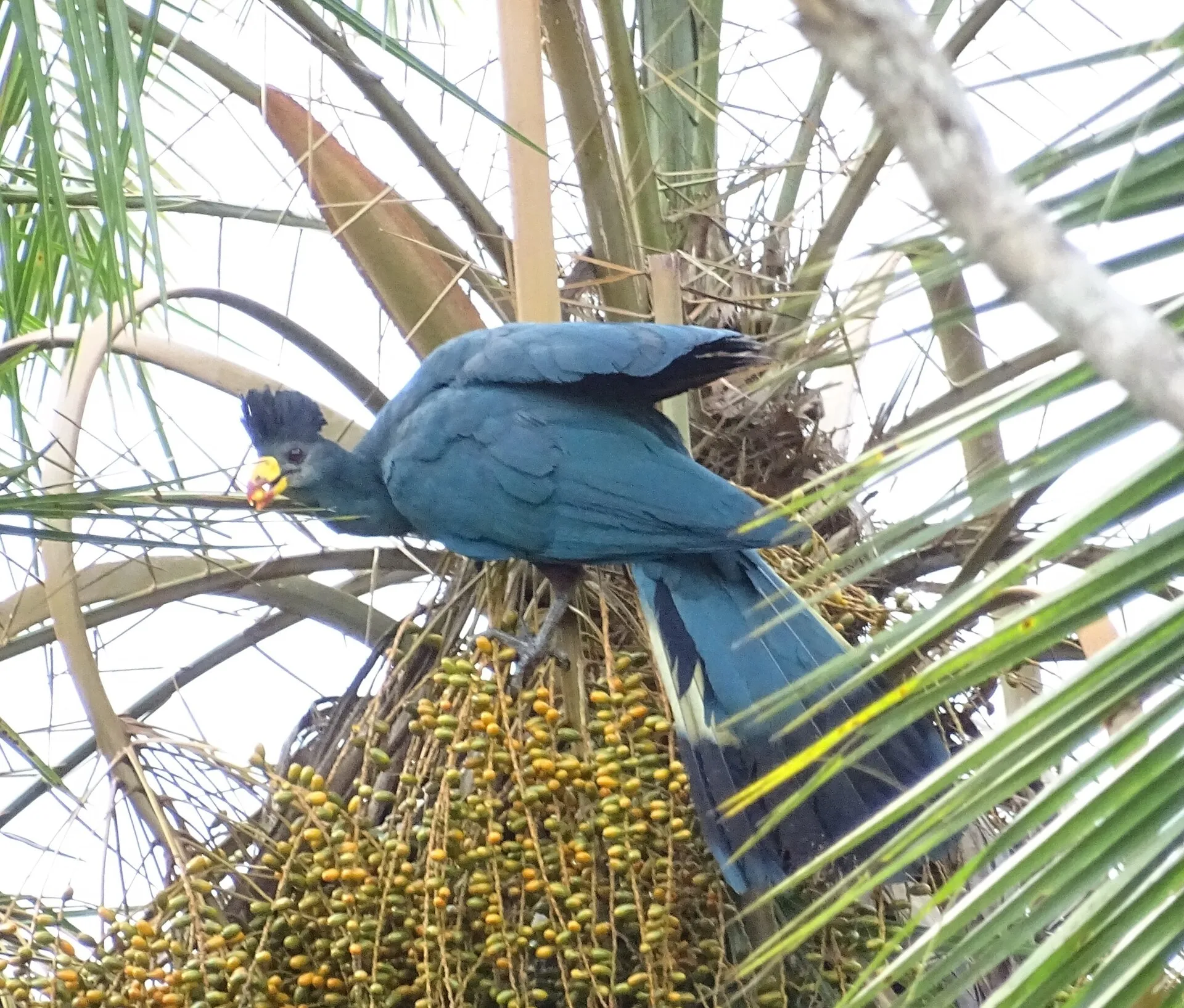
Great blue turacos live in groups of up to six or more, moving through the forest canopy. They are clumsy fliers, usually gliding from one tree to the next, but they run and hop along branches with ease. Their loud, far-carrying calls, a rolling ‘kok-kok-kok’ followed by bubbling notes, often reveal them before they are seen.
Diet
They feed mainly on fruit, especially figs, as well as leaves, flowers and buds. By dispersing seeds through the forest, they play an important role in forest regeneration.
Where to see great blue turacos
- Bigodi Wetland Sanctuary near Kibale: one of the most reliable sites in Uganda.
- Kibale National Park: along the forest trails and roads.
- Entebbe Botanical Gardens: often seen in the tall trees, perfect on arrival or departure day.
- Budongo Forest and Mabira Forest, and the lower forests around Bwindi.
Read great blue turaco for practical tips.
Listen for the loud ‘kok-kok-kok’ in the early morning, then scan the tops of fruiting trees. Groups often stay in the same tree for some time while feeding.
Other turacos in Uganda
Uganda has several other turacos, most with brilliant green plumage and crimson flight feathers that flash red in flight: the Rwenzori turaco of the Albertine Rift mountains, the black-billed turaco of Bwindi and Kibale, Ross’s turaco with its violet plumage and yellow face, and the white-crested turaco. Seeing several on one trip is a highlight of birding in Uganda.
Remarkable turaco facts
- Turacos are found only in Africa.
- Most turacos have unique copper-based pigments, turacin (red) and turacoverdin (green), found in no other bird group.
- They can rotate their outer toe forwards or backwards, helping them grip branches.
Best time to see them
Great blue turacos are resident and seen year-round. Mornings are best, when they are most active and vocal.
Other birds to look for at Bigodi and Kibale
Bigodi Wetland and Kibale’s forest edges are among Uganda’s richest birding sites. Alongside the great blue turaco, look for:
- Papyrus gonolek and white-winged warbler in the papyrus.
- Black bee-eater, yellow-spotted barbet and double-toothed barbet in the forest edge.
- Green-breasted pitta, a rare forest-floor jewel, in Kibale in the right season.
- African grey parrot, often heard calling overhead.
- Hornbills, including the black-and-white-casqued hornbill, whose loud wingbeats you can hear from far away as it flies over the canopy.
Photography tips
Great blue turacos are large and often sit in the open at the tops of trees, which makes them good subjects. Use a long lens, expose for the bright turquoise plumage and wait for a bird to turn its head so the light catches the yellow and red bill.
Frequently asked questions
Can great blue turacos fly well?
They are weak fliers, gliding from tree to tree and running and hopping along branches with surprising agility.
What do they eat?
Mainly fruit, along with leaves, flowers and shoots.
Are they endangered?
No. They are listed as Least Concern and are common in suitable forest, though they depend on forest protection.
Where is the easiest place to see one?
The Entebbe Botanical Gardens and the Bigodi Wetland Sanctuary near Kibale.
Is the great blue turaco related to other turacos?
Yes, but it is placed in its own genus, Corythaeola, and lacks the red flight feathers of most other turacos.
How can I tell a great blue turaco from other turacos?
By its size and colour: it is much larger than other turacos, mainly turquoise-blue rather than green, and lacks the red flight feathers that flash on most turacos in flight.

Written by our Kampala-based planners and guides, who arrange these trips every season. Prices and rules are checked before every quote.