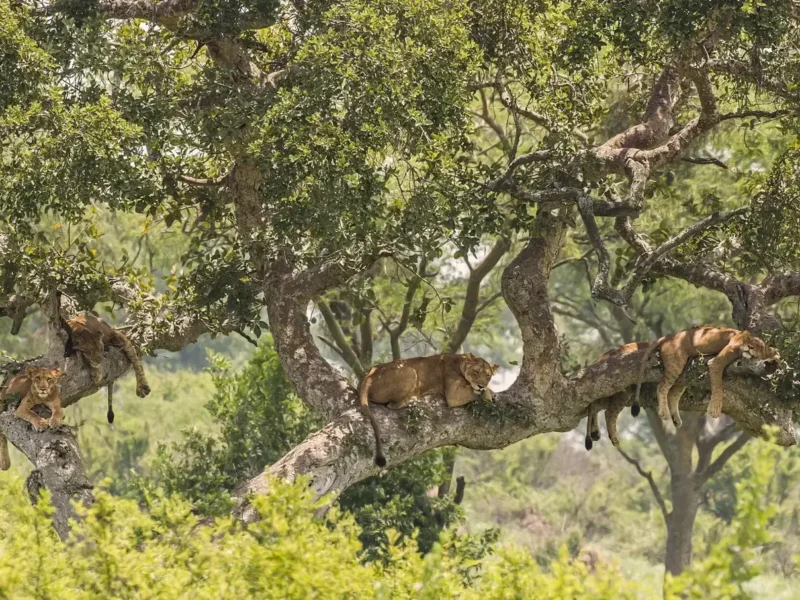
In the Ishasha sector of Queen Elizabeth National Park, lions regularly climb and rest in large sycamore fig and acacia trees, a behaviour seen in only a few places in Africa, including Tanzania’s Lake Manyara. Likely reasons include escaping biting flies, catching cooler breezes and gaining a view over the plains. Sightings are good but never guaranteed; the heat of the day is best.
Key takeaways
- Ishasha is the best place in Africa to see tree-climbing lions.
- Lions climb fig and acacia trees mostly in the heat of the day.
- Theories include escaping flies, cooler air and a better view.
- Uganda’s lion numbers have fallen; Queen Elizabeth’s population needs protection.
- Ishasha lies on the route between central Queen Elizabeth and Bwindi.
Lions are not built for climbing. They are heavy, with powerful front legs designed for grappling prey, not gripping branches. Yet in the Ishasha sector of Queen Elizabeth National Park, lions regularly haul themselves into the spreading branches of large sycamore fig trees and lie there for hours, legs dangling, looking down on the plains. It is one of the most unusual and photogenic sights in African wildlife.
Where it happens
Ishasha is the remote southern sector of Queen Elizabeth National Park, close to the border with Congo. Its open grassland is dotted with large, spreading fig and acacia trees, and it is home to large herds of Uganda kob and topi, the lions’ main prey. The lions here have climbed trees for as long as anyone can remember.
Tree-climbing lions are also seen occasionally in Tanzania’s Lake Manyara and Tarangire, but nowhere is the behaviour as regular as in Ishasha.
Why do they climb?
Researchers have suggested several explanations, and it may be a combination:
- Escaping flies: tsetse and other biting flies are fewer a few metres above the ground.
- Keeping cool: branches catch breezes during the hottest part of the day.
- A better view: from the trees, lions can watch the kob herds and spot danger.
- Learned behaviour: cubs learn to climb by copying adults, so the habit passes down through prides.
How to see them
Guides check the favourite trees on the Ishasha loops, where lions rest most often, and read fresh tracks and the behaviour of kob and other animals. Late morning to mid-afternoon is usually best, when lions retreat to the trees in the heat. Read tree-climbing lions of Ishasha for practical tips.
Bring a medium to long zoom. Lions in the branches are often partly hidden by leaves; patience and a slight change of angle can reveal a clear view of a face or a dangling paw.
Lions in Uganda: a conservation concern
Lions are classified as Vulnerable across Africa, and Uganda’s lion numbers have fallen in recent years. The Uganda Wildlife Authority’s 2026 State of Wildlife Resources report estimated 291 lions nationally in 2022/23, down from 373 in 2020, with a significant decline in Queen Elizabeth National Park. Threats include conflict with livestock owners, poisoning and snares. Tourism revenue and community programmes around the park are part of the response, and seeing these lions is a reminder of how precious they are.
Combining Ishasha with your trip
Ishasha lies on the route between central Queen Elizabeth and Bwindi’s Buhoma sector, so most visitors pass through on the way to gorilla trekking. Our 5-day gorillas and Queen Elizabeth wildlife safari includes a game drive through Ishasha, and a night at a camp in the sector gives you more time with the lions.
Other wildlife in Ishasha
Ishasha is wilder and quieter than the central part of Queen Elizabeth. Besides lions, look for large herds of Uganda kob and topi, buffalo, elephants and, along the Ntungwe River, hippos and forest birds. The open plains are also good for raptors, including bateleurs and martial eagles, and the papyrus swamps occasionally hold shoebills.
Where to stay
A few small camps and lodges lie in or near Ishasha, including tented camps on the Ntungwe River. Staying a night lets you search for the lions at different times of day, rather than passing through on a single drive.
Best time to visit
Ishasha can be visited year-round. The dry seasons, June to September and December to February, are best because the grass is shorter, the tracks are drier and lions are easier to spot in the trees. In the wettest months some tracks become muddy, and we may adjust the route.
Frequently asked questions
Why do lions climb trees in Ishasha?
No one knows for certain. The leading theories are that the branches lift them away from biting tsetse flies, catch cooling breezes in the heat of the day, and give a vantage point over the Uganda kob they hunt.
Are the tree-climbing lions guaranteed?
No. Lions move around, and some days they rest on the ground. Guides check the favourite trees and recent tracks to give you the best chance.
When is the best time to see them?
From late morning to mid-afternoon, especially in the dry seasons.
Do lions climb trees elsewhere?
Yes, occasionally in Lake Manyara and Tarangire in Tanzania and in parts of the Serengeti, but Ishasha is the most reliable place.
How do I get to Ishasha?
It is in the far south of Queen Elizabeth National Park, on the route between the central park and Bwindi’s Buhoma sector, about 2–3 hours from either.

Written by our Kampala-based planners and guides, who arrange these trips every season. Prices and rules are checked before every quote.