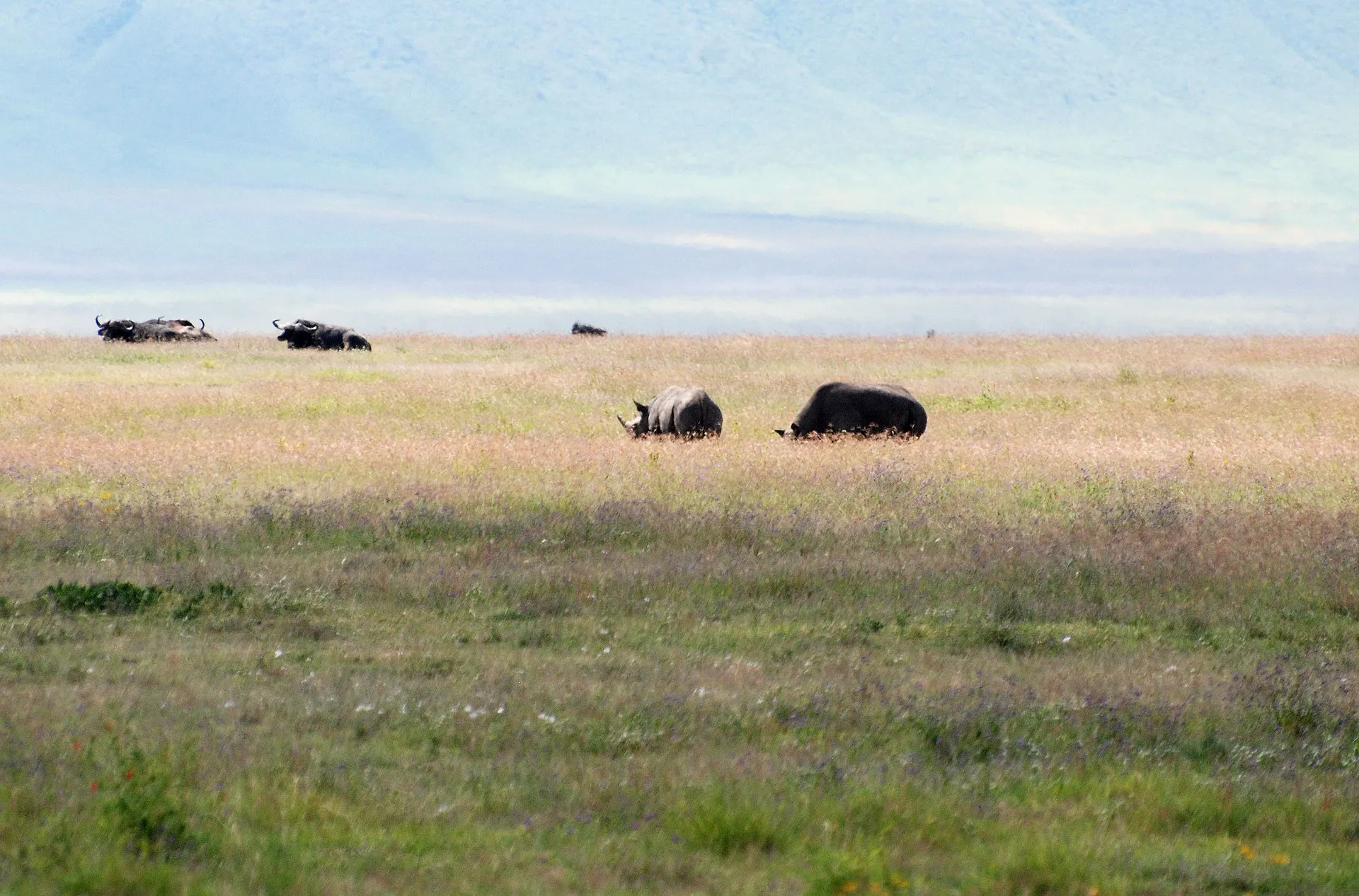
Ngorongoro Crater holds a small, closely protected population of black rhinos, roughly a few dozen animals, which are monitored by rangers. They are often seen at a distance on the open grassland of the crater floor, so binoculars and a patient guide make a big difference. In 2025, southern white rhinos were also introduced to the wider conservation area.
Key takeaways
- A small, closely monitored population.
- Usually seen at a distance on the open floor.
- Bring binoculars or a long lens.
- White rhinos were introduced to the wider conservation area in 2025.
Black rhinos once lived across East Africa, but poaching in the 1970s and 1980s destroyed most populations. In Ngorongoro Crater, numbers fell from more than a hundred in the 1960s to a small remnant. Strict protection since then has allowed a slow recovery.
Black or white?
Both species are grey. The difference is the lip: the black rhino has a pointed, hooked upper lip for browsing leaves and shrubs, while the white rhino has a wide, square lip for grazing grass. Black rhinos are usually smaller, more solitary and shyer. In Uganda, you can track white rhinos on foot at Ziwa.
How they are protected
Rangers monitor the rhinos daily, and many are individually known. Vehicles must stay on the tracks, so sightings are often from a respectful distance. This protection is the reason they survive.
Tips for spotting them
- Scan the open grassland: a dark grey shape, often lying down, can look like a rock.
- Ask your guide to check with other drivers by radio.
- Be patient; a rhino may stand up and walk after a long rest.
- Use binoculars or a 400 mm+ lens for photos.
When to go
Rhinos can be seen all year. The dry season, June to October, has shorter grass, which helps visibility. Early mornings are best, when rhinos are more active and the light is soft.
Good to know
- Rhino sightings are never guaranteed, even in the crater.
- The crater service fee is US$295 per vehicle per descent.
- Combine with a day on the crater floor to see the full range of wildlife.
- The rim is cold early; bring a warm layer.
Who it suits
Rhino spotting suits patient wildlife watchers and anyone completing their Big Five. In Kenya, Lake Nakuru and Ol Pejeta offer more rhino sightings, and Ol Pejeta also protects the last two northern white rhinos. On a Tanzania safari, though, the crater is the place to try, and seeing a wild black rhino in such a setting is unforgettable.
White rhinos in Ngorongoro
In 2025, southern white rhinos were translocated from South Africa to the Ngorongoro Conservation Area, the first of a planned larger group. They were released gradually into areas outside the crater, so sightings of white rhinos may become possible over time. Your guide will know the latest situation.
Rhino conservation in Tanzania
Tanzania’s black rhinos live in a few protected strongholds, including the Serengeti, Ngorongoro and Mkomazi, where a sanctuary breeds rhinos for release. Anti-poaching patrols, monitoring and community programmes have stabilised numbers. Every visitor’s park fees contribute to this work.
Other wildlife on the floor
While searching for rhinos, you will see lions, spotted hyenas, golden and black-backed jackals, buffalo, zebra, wildebeest, Grant’s and Thomson’s gazelles, hippos, elephant bulls and flamingos.
Photography
Rhinos are often far away, so a 400–600 mm lens and a stable support help. Heat haze in the middle of the day can soften images, so early morning gives the sharpest results.
How many days do I need?
A single crater day gives a reasonable chance of a distant black rhino. If seeing one is a priority, plan two descents on different days, or combine the crater with Kenya’s Lake Nakuru or Ol Pejeta, where rhinos are easier to see.
Black rhino facts
Black rhinos weigh up to about 1,400 kg, stand around 1.5 metres at the shoulder and can run at over 50 km/h. They are mostly solitary, browse on shrubs and leaves, and are most active in the early morning and evening. Mothers keep their calves close for two to three years.
Plan it
Our 3-day Tarangire and Ngorongoro safari and 7-day Tanzania northern circuit safari both include a crater day.
Frequently asked questions
How many black rhinos live in Ngorongoro?
A small population of a few dozen; exact figures are kept confidential for security.
Can I get close to them?
No. Vehicles stay on the tracks, so sightings are often at a distance.
Is the crater the best place in Tanzania for rhino?
It is the most reliable on a standard northern circuit safari.
What other rhino places are there?
Lake Nakuru and Ol Pejeta in Kenya, and Ziwa in Uganda for white rhinos.
Why are the rhinos often far away?
They prefer open grassland and quiet areas away from the tracks, and vehicles must stay on the roads.
Can I see white rhinos in Ngorongoro?
Possibly in future, after white rhinos were introduced to the wider conservation area in 2025.

Written by our Kampala-based planners and guides, who arrange these trips every season. Prices and rules are checked before every quote.