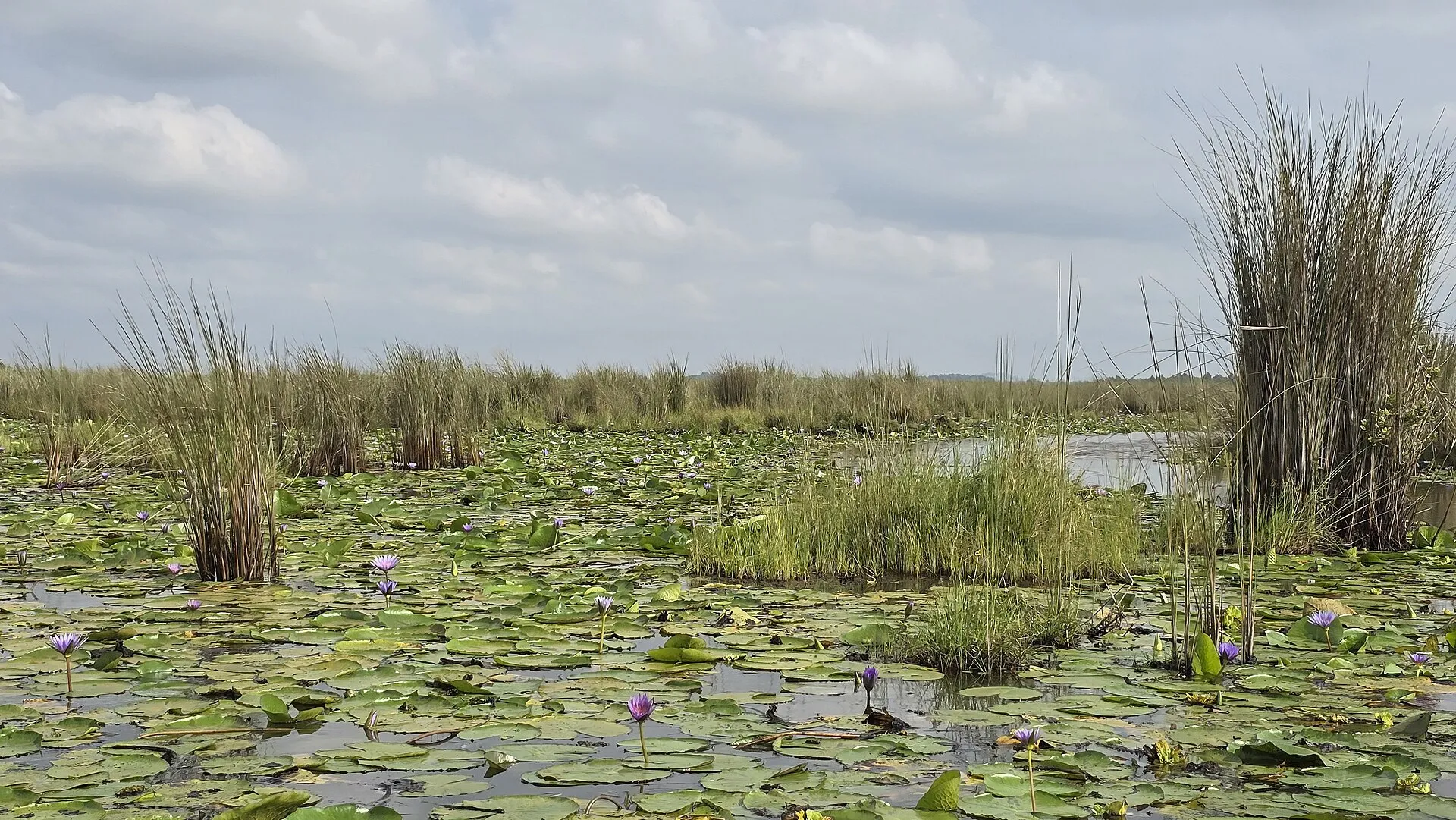
The papyrus gonolek is a striking bushshrike with a crimson breast, black back and golden crown. It lives only in papyrus swamps in the Great Lakes region, and in Uganda it is seen at Mabamba Swamp, Bigodi Wetland, Lake Mburo and Lutembe Bay. Pairs sing in duet, which is often the first sign of the bird.
Key takeaways
- A papyrus swamp specialist.
- Crimson breast, black back and golden crown.
- Pairs sing loud duets.
- Seen at Mabamba, Bigodi and Lake Mburo.
The papyrus gonolek is one of several birds that depend entirely on papyrus swamps. Others include the white-winged swamp warbler and the papyrus canary. As swamps are drained for farming, these birds are losing habitat.
Identification
- Crimson red throat and breast.
- Black back and wings, with a white wing bar.
- Golden-yellow crown.
- A bushshrike about 18 cm long.
Behaviour
Pairs live in territories in the papyrus. They duet: one bird calls, and the other answers so quickly that it sounds like one song. They feed on insects, often low down in the papyrus stems.
Where to see it
- Mabamba Swamp, on the shoebill canoe trip.
- Bigodi Wetland, near Kibale.
- Lake Mburo, especially on the boat trip and around the swamps.
- Lutembe Bay, on Lake Victoria near Entebbe.
When to go
Papyrus gonoleks are resident and can be seen year-round. Mornings are best, when they call most often.
Good to know
- Listen for the duet, then search low in the papyrus.
- Be patient; birds may show briefly.
- Binoculars help pick out the red against the green.
- Wear waterproof shoes at swamp edges.
Who it suits
The papyrus gonolek suits birders adding Great Lakes specialists to their lists, and photographers looking for colour. It is also a lovely bonus on a shoebill or primate walk.
Protecting papyrus
Papyrus swamps filter water, protect shorelines and support fish breeding. Community tourism, such as the Mabamba canoe trips and the Bigodi Wetland walk, gives local people a reason to protect them.
Other papyrus specialists
While you look for the gonolek, watch for other birds that live only in papyrus:
- White-winged swamp warbler, a skulking, streaky bird.
- Papyrus yellow warbler, rare and restricted to a few swamps.
- Carruthers’s cisticola, which sings from the papyrus heads.
- Papyrus canary, a small yellow seedeater.
Mabamba and Lutembe Bay near Entebbe are good places to look for these, and a local bird guide will know where each one has been seen recently.
Bushshrikes
The papyrus gonolek belongs to the bushshrike family, a group of African birds known for bright colours and loud, varied calls. Many bushshrikes sing in duets, with pairs answering each other so precisely that it sounds like one bird.
Where to stay
For Mabamba, stay in Entebbe. For Bigodi, stay near Kibale. For Lake Mburo, stay at a lodge in or near the park.
Photography tips
Gonoleks move quickly in dense papyrus, so a fast shutter speed and patience are essential. Wait near a spot where the bird has been calling, and photograph it when it climbs to the top of a stem.
Papyrus swamps under threat
Papyrus swamps around Lake Victoria and the western Ugandan lakes are being drained for farming, brick-making and settlement. When the papyrus goes, so do the gonolek, the white-winged swamp warbler and the sitatunga antelope. Community tourism shows that swamps can earn money when they are left intact.
Who it suits
Birders, photographers and anyone who enjoys colourful birds.
How to find the gonolek
Listen first. The duet is a loud, ringing call followed by a harsh churr, repeated often in the morning. Once you hear it, scan the lower and middle levels of the papyrus, where the bird moves in short hops. Gonoleks are shy but curious, and they often pop up briefly to look at visitors. A guide familiar with local territories will know where pairs live, which makes a big difference. On a canoe at Mabamba, the boatman can hold the canoe still near the papyrus edge, giving you time to wait for the bird to appear.
Plan it
See it on our 1-day Mabamba shoebill trip or 7-day Uganda birding safari. See our birders’ travel guide.
Frequently asked questions
Is the papyrus gonolek rare?
It is near threatened because papyrus swamps are shrinking, but common where habitat remains.
Where is the easiest place to see it?
Mabamba Swamp and Bigodi Wetland.
What does it eat?
Insects and small invertebrates in the papyrus.
How do I find it?
Listen for the duet and look low in the papyrus.
Can I see it on the shoebill trip?
Yes. Mabamba’s papyrus channels are one of the best places, and guides often point it out on the way to the shoebill.
When is the best time to see the gonolek?
Early morning, when pairs are calling and active.
Where is the gonolek’s range?
Papyrus swamps around Lake Victoria and the Great Lakes, in Uganda, Rwanda, Kenya, Tanzania, Burundi and Congo.

Written by our Kampala-based planners and guides, who arrange these trips every season. Prices and rules are checked before every quote.