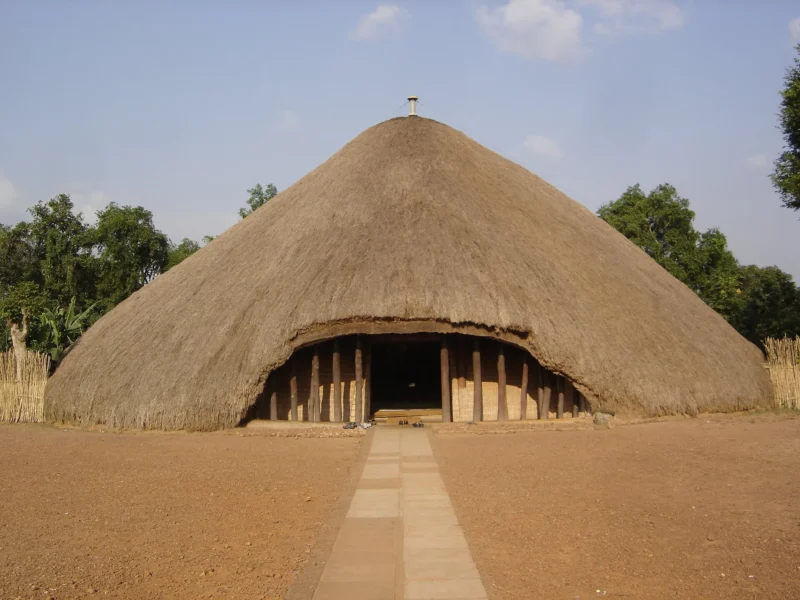
The Uganda Martyrs Shrine at Namugongo, about 15 km from Kampala, marks the place where Christian converts were killed on the orders of Kabaka Mwanga II, most famously on 3 June 1886. The Catholic basilica, shaped like a traditional hut, stands over the site where Charles Lwanga was burned. Every 3 June, Martyrs Day, very large crowds of pilgrims gather, many walking from across East Africa.
Key takeaways
- Site of the 1886 martyrdoms.
- The basilica is shaped like a traditional hut.
- Martyrs Day on 3 June draws huge crowds.
- Catholic and Anglican shrines nearby.
In the 1880s, the court of Buganda was divided between traditional beliefs, Islam, Catholicism and Protestantism. Kabaka Mwanga II saw the young Christian pages at his court as a threat to his authority. Between 1885 and 1887, many converts, both Catholic and Anglican, were killed. The largest group was burned alive at Namugongo on 3 June 1886.
The martyrs
Twenty-two Catholic martyrs, led by Charles Lwanga, were canonised by Pope Paul VI in 1964. The Anglican Church remembers its martyrs too, and the Anglican shrine and museum at Namugongo tell their story.
The basilica
The Catholic basilica was built over the place where Charles Lwanga was killed. Its shape recalls a traditional Kiganda hut, and its 22 copper-clad pillars represent the 22 Catholic martyrs. Inside, the altar stands over the site of the burning. Pope Paul VI visited in 1969, the first visit by a pope to sub-Saharan Africa, followed by Pope John Paul II in 1993 and Pope Francis in 2015.
Martyrs Day
On 3 June each year, pilgrims gather at Namugongo for Martyrs Day. Many walk for days or weeks from across Uganda and neighbouring countries. Crowds are very large, and the area is busy for several days.
Visiting
The grounds include the basilica, a lake used for prayer, and the Anglican shrine and museum. Guides explain the history, and the atmosphere is peaceful outside the pilgrimage season.
When to go
Visit year-round. Around 3 June, expect huge crowds and traffic; choose another time for a quiet visit, or come specifically to experience the pilgrimage with a guide.
Good to know
- Dress modestly.
- Photography is generally allowed outside services; be respectful inside.
- Entry is free, but donations are welcome.
- Combine with the Kasubi Tombs on a Kampala day.
Who it suits
Namugongo suits pilgrims, history lovers and travellers interested in religion and culture. It is a moving visit even for those of no faith.
Understanding the history
The martyrdoms happened at a time of great change in Buganda, as foreign religions and powers arrived. Your guide will explain both the faith of the martyrs and the political pressures on the kabaka, giving a balanced picture of a complex period. See also the Buganda Kingdom palace.
A visit step by step
Arrive at the Catholic basilica, where a guide explains the history and shows you the altar and the stained glass. Walk down to the martyrs’ lake and the open-air amphitheatre used for the Martyrs Day mass. Then drive a short distance to the Anglican shrine, where a museum displays the story of the martyrs through paintings and models, and marks the place where many of them were killed. A full visit takes about two hours.
Martyrs Day pilgrimage
In the days before 3 June, pilgrims arrive on foot, some after walking hundreds of kilometres from Kenya, Tanzania, Rwanda and across Uganda. They camp around the shrine, sing and pray. On the day itself, mass is celebrated for enormous crowds, with bishops and leaders from across Africa. If you want to experience it, plan carefully: roads are closed, accommodation is scarce and the crowds are huge. A guide is essential.
Getting there
Namugongo is about 15 km north-east of central Kampala, off the Kampala–Jinja road. The drive takes 30 to 60 minutes, depending on traffic. It is easy to combine with a city tour, or to visit on the way to Jinja and the source of the Nile. Around 3 June, roads are closed and the area becomes very congested, so plan to arrive very early or stay nearby.
Other memorials
Other places linked to the martyrs include Munyonyo, on Lake Victoria, where the first martyrs were killed and a newer shrine now stands, and the Kampala cathedrals at Rubaga (Catholic) and Namirembe (Anglican), which also tell the story of Christianity’s arrival in Uganda.
Plan it
Add Namugongo to our 1-day Kampala city tour or a pilgrimage-themed trip. Ask for tailor-made pricing.
Frequently asked questions
When is Martyrs Day?
3 June every year.
How far is Namugongo from Kampala?
About 15 km.
Can non-Christians visit?
Yes. Visitors of all faiths are welcome.
How many martyrs were canonised?
Twenty-two Catholic martyrs, in 1964.
Is there an entry fee?
Entry is free; donations are welcome.
Is there a museum at Namugongo?
Yes. The Anglican shrine has a museum telling the story of the martyrs with paintings and models.

Written by our Kampala-based planners and guides, who arrange these trips every season. Prices and rules are checked before every quote.