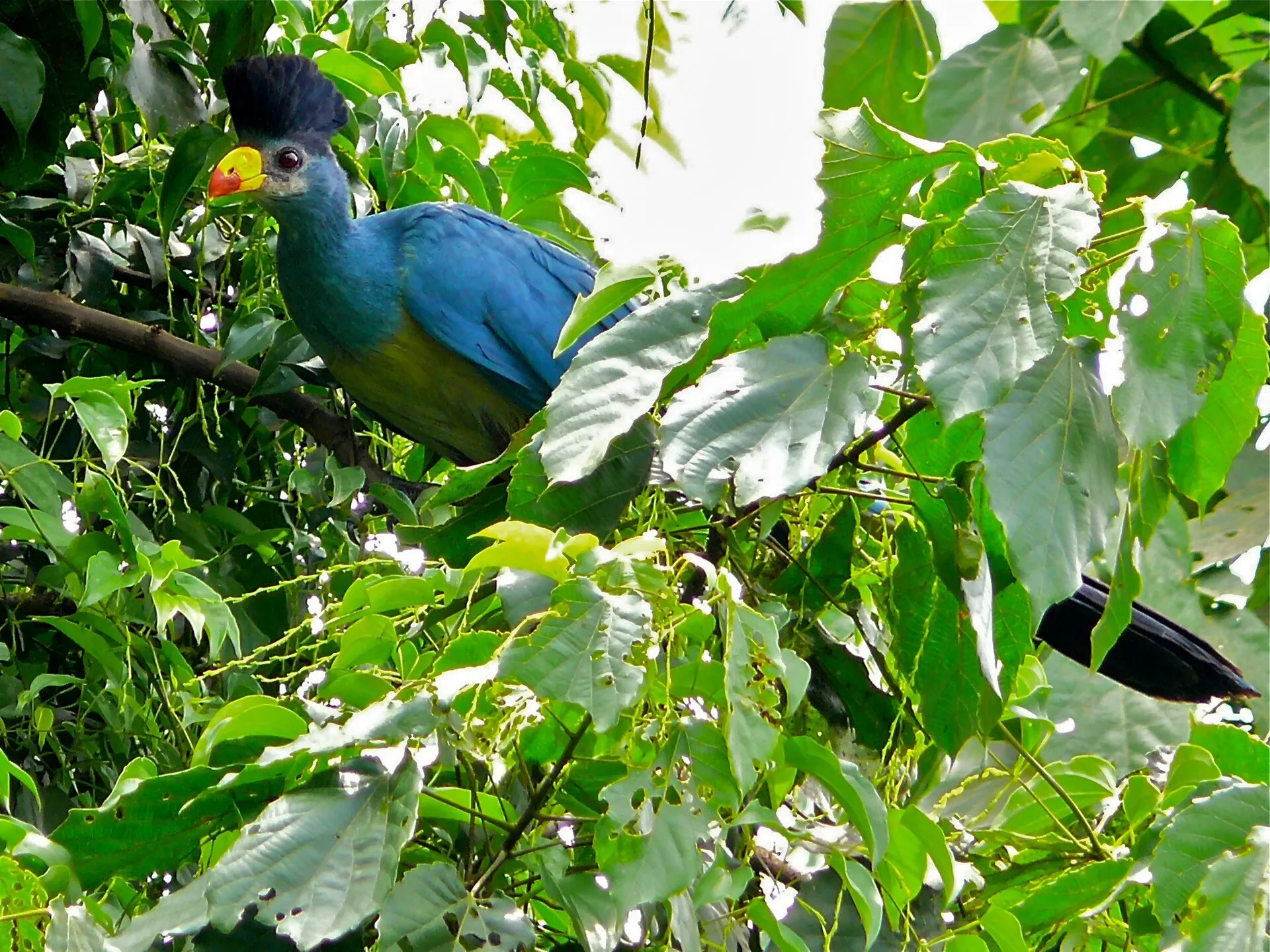
The great blue turaco is the largest turaco, about 75 cm long. It lives in forests and wooded areas across Uganda, and is easy to see in Kibale, Bigodi Wetland, Entebbe Botanical Gardens and Bwindi. It moves through the canopy in short glides and hops, and its loud, bubbling call often reveals it before you see it.
Key takeaways
- The largest turaco, about 75 cm long.
- Easy to see in Kibale, Bigodi and Entebbe.
- Loud, bubbling call.
- Feeds mostly on fruit and leaves.
The great blue turaco is a favourite of birders and non-birders alike, and this guide explains where to see the great blue turaco. Its size, colours and noisy behaviour make it impossible to miss.
Identification
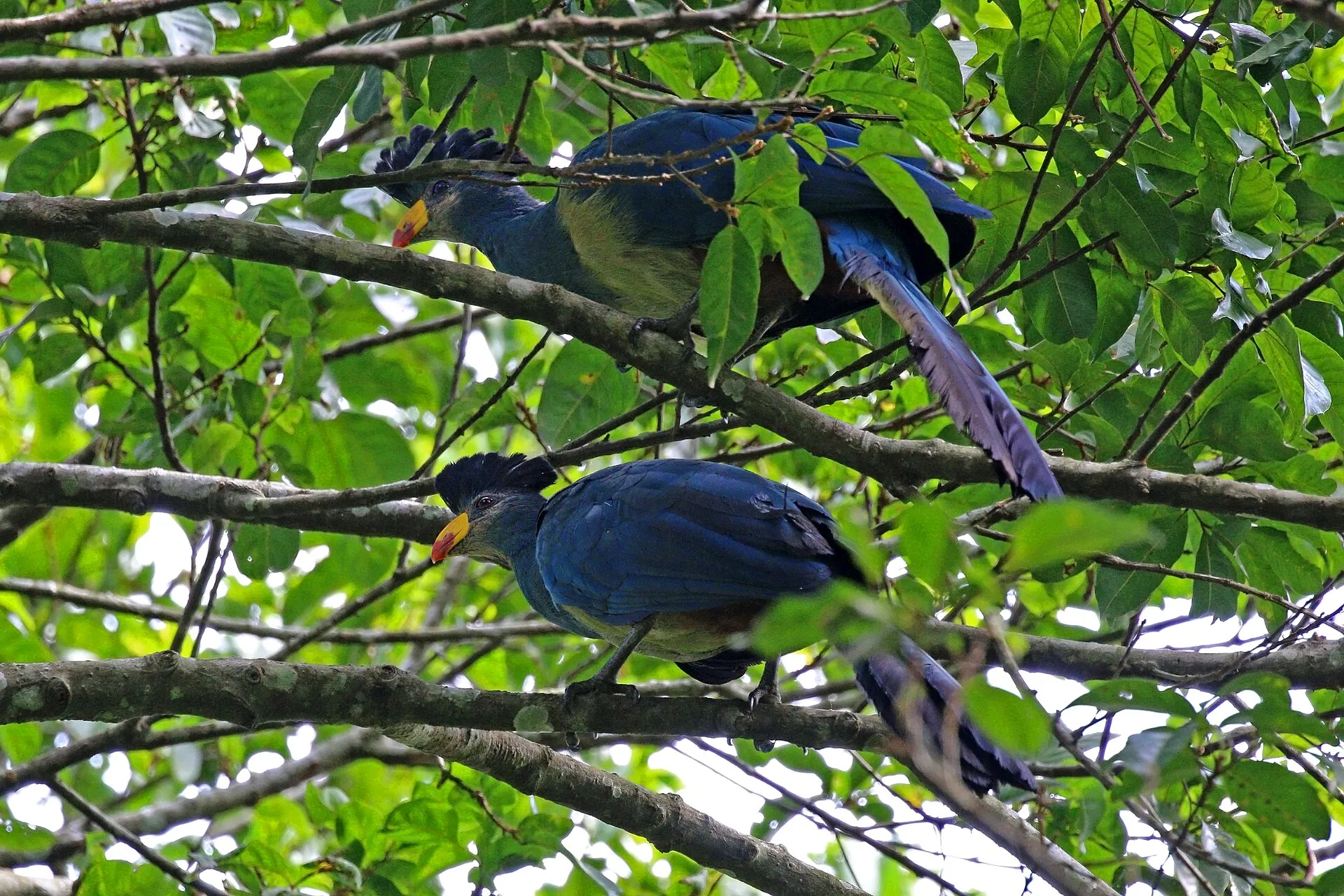
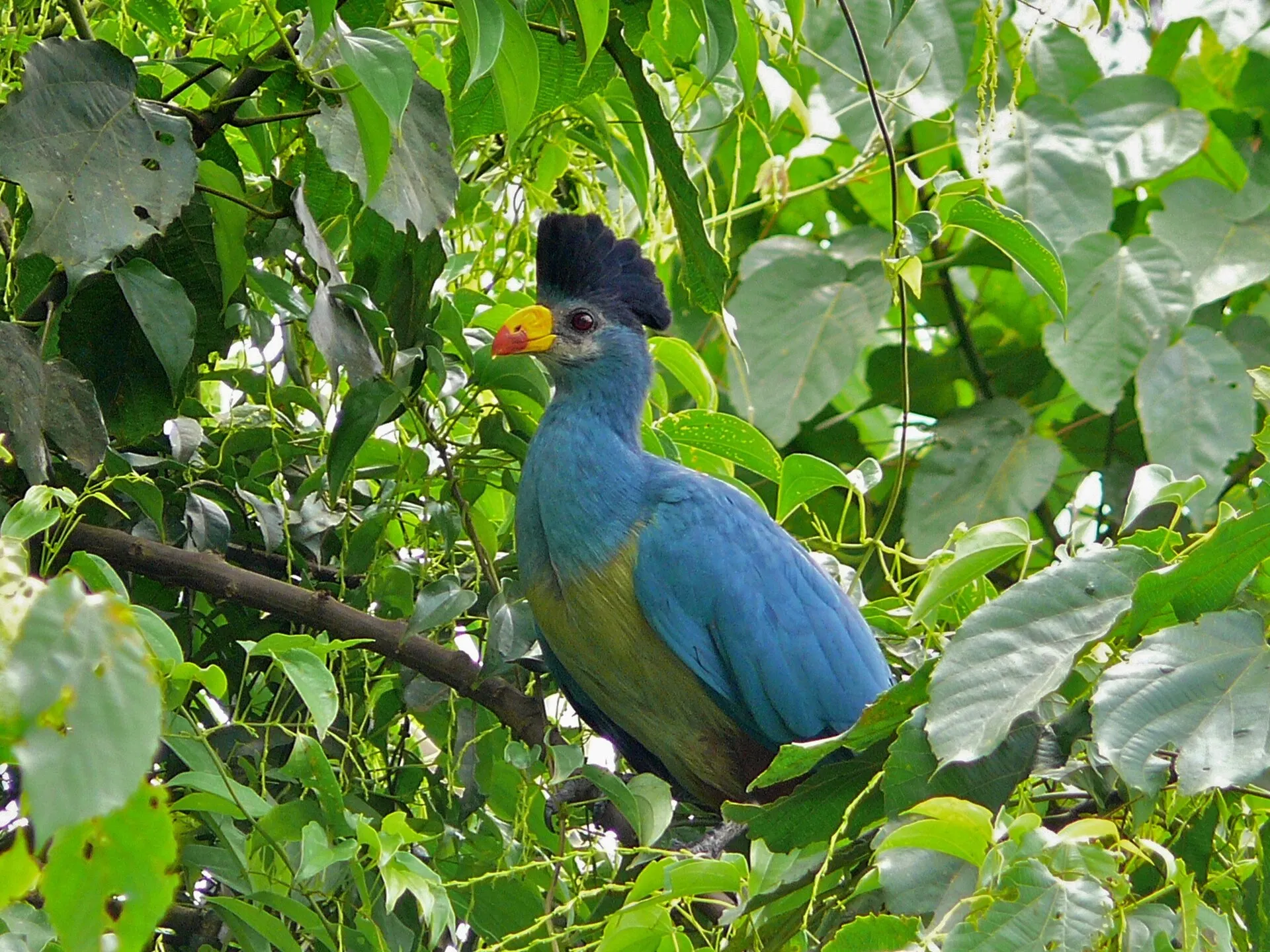
- Blue-turquoise upperparts with a long tail.
- Black crest that stands up like a fan.
- Yellow-green belly.
- Bright yellow bill with a red tip.
Unlike many other turacos, it does not show red in its wings.
Behaviour
Great blue turacos live in small groups that move through the trees. They glide from tree to tree and run along branches. They feed on fruit, leaves and flowers. Their call, a deep “kok-kok-kok” followed by a bubbling trill, carries far through the forest.
Where to see it
- Kibale Forest and the Bigodi Wetland walk.
- Entebbe Botanical Gardens, close to the airport.
- Bwindi and other forests across Uganda.
When to go
Great blue turacos can be seen year-round. Mornings are best, when they are most active and calling.
Good to know
- Listen first; the call leads you to the bird.
- Binoculars help you follow them in the canopy.
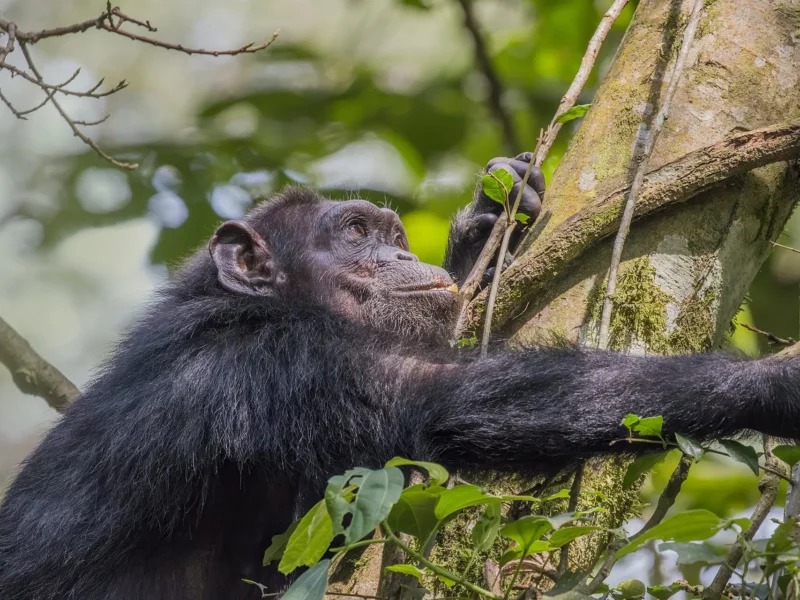
- Turacos are often seen on chimp treks in Kibale.
- Entebbe is the easiest place for a quick sighting.
Who it suits
The great blue turaco is a highlight for birders, photographers and families. It is often one of the first big forest birds visitors see in Uganda.
Photography tips
Turacos often perch high in the canopy, against a bright sky. Use exposure compensation to avoid silhouettes, and look for birds lower down at forest edges, where the light is better. In Entebbe, birds often feed in trees at eye level.
Turacos in Uganda
Uganda has several turaco species, each with its own range:
- Ross’s turaco, purple-blue with a yellow face, often in Queen Elizabeth and Lake Mburo.
- Black-billed turaco, green with red wings, in Kibale and Bwindi.
- Rwenzori turaco, with brilliant colours, in Bwindi and Mgahinga.
- White-crested turaco, in Murchison and the north.
- Bare-faced go-away-bird in the drier savannahs.
The great blue turaco is the biggest of them all, and lacks the red wing feathers that most other turacos flash when they fly.
Turacos and their colours
Turacos are a family of birds found only in Africa. Many species have brilliant green and red feathers, coloured by unique pigments, turacoverdin and turacin, found in no other bird family. The great blue turaco is unusual, with blue and green colouring and no red in its wings.
Breeding
Great blue turacos build loose platform nests of sticks in trees and lay two eggs. Both parents incubate and feed the chicks, which leave the nest before they can fly well, climbing around the branches.
Where to stay
In Kibale, lodges near Kanyanchu and Bigodi are surrounded by forest where turacos are often seen. In Entebbe, hotels near the Botanical Gardens are perfect for a morning walk.
Who it suits
The great blue turaco suits everyone, from serious birders to families. It is one of the easiest big forest birds to see in Uganda, and it often feeds at eye level along forest edges.
Calls
Learn the call before you go: a deep, repeated “kok-kok-kok” that rises into a bubbling trill. Once you know it, you will hear turacos everywhere in Uganda’s forests.
Where to see it, region by region
- Central Uganda: Entebbe Botanical Gardens, Mabira Forest and Zika Forest near Entebbe.
- Western Uganda: Kibale, Bigodi Wetland, the crater lakes around Fort Portal and Semuliki.
- South-western Uganda: Bwindi, especially around Buhoma, and Echuya Forest.
- Rwanda: Nyungwe and Gishwati-Mukura.
- Kenya: Kakamega Forest in the west.
Wherever there is healthy forest, there is a good chance of hearing its call.
Did you know?
Turacos are among the few birds that can run along branches like squirrels.
Plan it
See it on our 2-day Kibale chimpanzee safari or 7-day Uganda birding safari.
Frequently asked questions
Is the great blue turaco rare?
No. It is common in suitable forest in Uganda.
Where is the easiest place to see one?
Entebbe Botanical Gardens or Bigodi Wetland.
What does it eat?
Mainly fruit, leaves and flowers.
How big is it?
About 75 cm long, the largest turaco.
Do great blue turacos live in pairs?
They usually live in pairs or small family groups of up to about six birds, which move through the canopy together.
Is the great blue turaco endangered?
No. It is listed as least concern, though forest loss affects it locally.
Where can I see it near Entebbe?
Entebbe Botanical Gardens, a short drive from the airport, is the easiest place.

Written by our Kampala-based planners and guides, who arrange these trips every season. Prices and rules are checked before every quote.