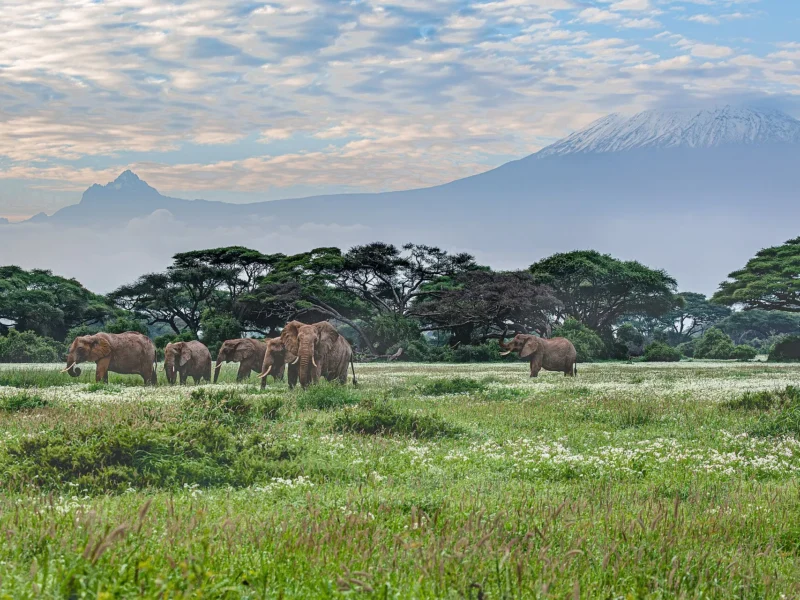
Africa has two elephant species: the savanna elephant, listed as Endangered, and the smaller forest elephant, listed as Critically Endangered since 2021. Both occur in Uganda, which counted about 6,350 elephants in its latest survey (2023–25), mostly in Queen Elizabeth and Murchison Falls. Elephants live in matriarchal family groups and can weigh up to about 6 tonnes. Amboseli, Tarangire and Queen Elizabeth are among the best places to see them.
Key takeaways
- There are two African species: savanna (Endangered) and forest (Critically Endangered).
- Families are led by the oldest female, the matriarch.
- Uganda’s latest count is about 6,350 elephants.
- An adult can eat well over 100 kg of vegetation a day.
- Amboseli, Tarangire and Queen Elizabeth offer the best viewing.
Few sights on safari are as moving as a family of elephants crossing a river or feeding quietly in the evening light. Elephants are social, intelligent and long-lived, with strong family bonds and memories that last decades. In East Africa you can see them in savannah, swamp and forest.
Two species
Scientists now recognise two African elephant species:
- The savanna elephant (Loxodonta africana), the larger of the two, found across the savannahs and woodlands of eastern and southern Africa. Listed as Endangered.
- The forest elephant (Loxodonta cyclotis), smaller, with rounder ears and straighter tusks, living in the rainforests of central and West Africa. Listed as Critically Endangered.
Uganda is unusual because both species, and hybrids between them, occur here: forest elephants in Kibale and the Semuliki valley, savanna elephants in Queen Elizabeth, Murchison Falls and Kidepo.
Family life
Elephant society is matriarchal. Family groups of related females and their young are led by the oldest female, the matriarch, whose knowledge of water sources, food and danger guides the group. Young males leave the family in their teens and live alone or in loose bachelor groups. Families greet each other with rumbles, trumpets and touching, and they appear to mourn their dead.
What they eat
Elephants eat grasses, leaves, bark, roots and fruit, often more than 100 kg a day, and drink large amounts of water. They shape their habitats by pushing over trees, opening paths and spreading seeds in their dung, which is why they are called ecosystem engineers.
Elephants in Uganda
Uganda’s elephants were devastated by poaching during the 1970s and 1980s, when numbers fell to a few hundred in some parks. Protection since then has allowed a strong recovery. The Uganda Wildlife Authority’s 2026 State of Wildlife Resources report counted about 6,350 elephants in 2023–25, slightly down from the previous survey, with the largest populations in Queen Elizabeth and Murchison Falls. Kibale’s forest elephants have increased to about 700. Poaching and snares remain threats.
Where to see elephants
| Park | Country | Why go |
|---|---|---|
| Queen Elizabeth | Uganda | Elephants drinking along the Kazinga Channel |
| Murchison Falls | Uganda | Large herds along the Nile |
| Amboseli | Kenya | Big-tusked elephants with Kilimanjaro behind |
| Tarangire | Tanzania | Herds of hundreds in the dry season |
| Kidepo | Uganda | Wild herds in a remote valley |
The Kazinga Channel boat cruise is one of the best ways to watch elephants closely as they come down to drink and bathe.
Watching elephants responsibly
Good guides keep a respectful distance and switch off the engine so elephants can pass undisturbed. Signs of stress include ears spread wide, head shaking and mock charges; your guide will move away calmly. Never get between a mother and her calf.
Elephants look most impressive at low angles. From a vehicle or boat, wait for them to approach water or walk towards you, and use the soft light of early morning or late afternoon.
Best time to see elephants
Elephants are seen year-round in all these parks. In the dry seasons, June to October and December to February, they gather near rivers, swamps and lakes, which makes them easier to find, especially in Tarangire and Amboseli.
Remarkable elephant facts
- An elephant’s trunk contains tens of thousands of muscles and can lift heavy branches or pick a single fruit.
- Elephants communicate with low-frequency rumbles that can travel several kilometres through the ground and air.
- Tusks are elongated incisor teeth; some elephants are born without them, a trait that became more common where ivory poaching was intense.
- Calves can stand within an hour of birth and are cared for by the whole family, not just their mother.
Frequently asked questions
What is the difference between savanna and forest elephants?
Forest elephants are smaller, with rounder ears and straighter, downward-pointing tusks, and live in dense forest. Savanna elephants are larger with bigger, more triangular ears and curved tusks. Both, and hybrids, are found in Uganda.
How long do elephants live?
Often 60–70 years in the wild.
How long is an elephant pregnancy?
About 22 months, the longest of any land mammal.
Are elephants dangerous?
Elephants are usually calm in protected areas but can be dangerous if surprised or if a calf is threatened. Guides keep a respectful distance and read their behaviour.
Where can I see elephants with Kilimanjaro behind them?
In Amboseli National Park in Kenya, especially at sunrise.

Written by our Kampala-based planners and guides, who arrange these trips every season. Prices and rules are checked before every quote.