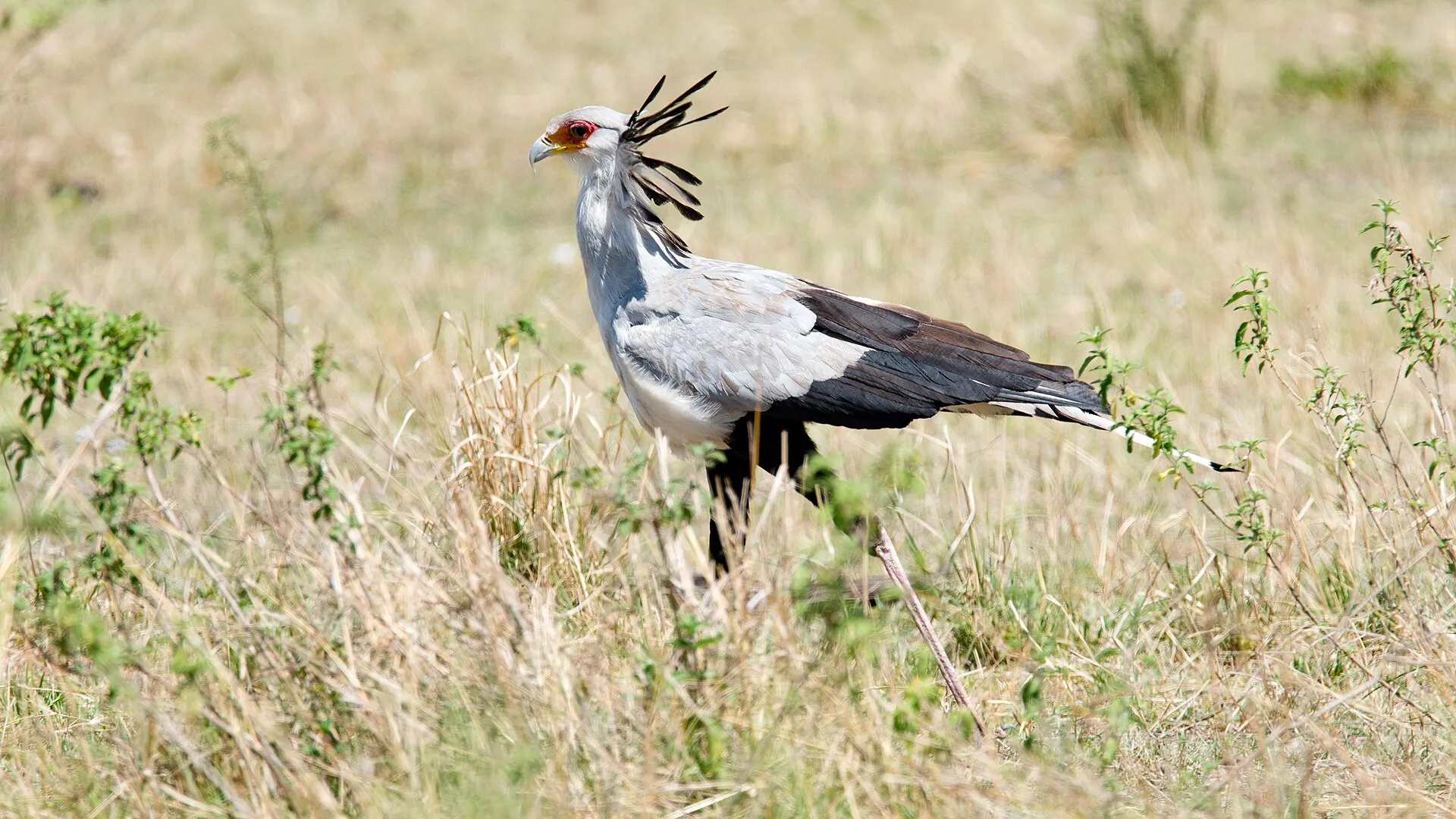
The secretary bird is a large bird of prey that hunts on foot, walking across grasslands to find snakes, rodents, insects and lizards, which it kills with powerful kicks. It stands over a metre tall, with long legs and a crest of black feathers. The Serengeti’s open plains are one of the best places to see it, and it is also found in the Masai Mara and Kidepo.
Key takeaways
- A raptor that hunts on foot.
- Kills prey with powerful kicks.
- Listed as endangered.
- Common on the Serengeti plains.
The secretary bird is so unusual that it has its own family. Its name is often said to come from its crest feathers, which look like quill pens tucked behind an ear.
How it hunts
Secretary birds walk many kilometres a day through the grass, flushing prey. When they find a snake or rodent, they strike with fast, powerful kicks. Research shows that the force of a kick can be several times the bird’s body weight, delivered in a fraction of a second.
Identification
- Grey body, black flight feathers and black “trousers”.
- Long, pink-orange legs.
- Orange-red bare face.
- Crest of long black feathers at the back of the head.
Why it is endangered
The secretary bird was uplisted to endangered in 2020. It is threatened by habitat loss, overgrazing, disturbance and collisions with power lines.
Where to see it
- Serengeti, especially the short-grass plains.
- Masai Mara, Kenya.
- Kidepo Valley, Uganda.
- Nairobi National Park.
When to go
Secretary birds are resident and can be seen year-round. The green season, when the grass is short and insects abundant, often brings good sightings.
Good to know
- Look for a tall bird walking slowly through the grass.
- They nest on flat-topped acacias.
- Bring binoculars and a zoom lens.
- They often fly when disturbed; keep a distance.
Who it suits
Secretary birds fascinate birders, photographers and families. Children love their long legs and snake-stamping reputation.
On the plains
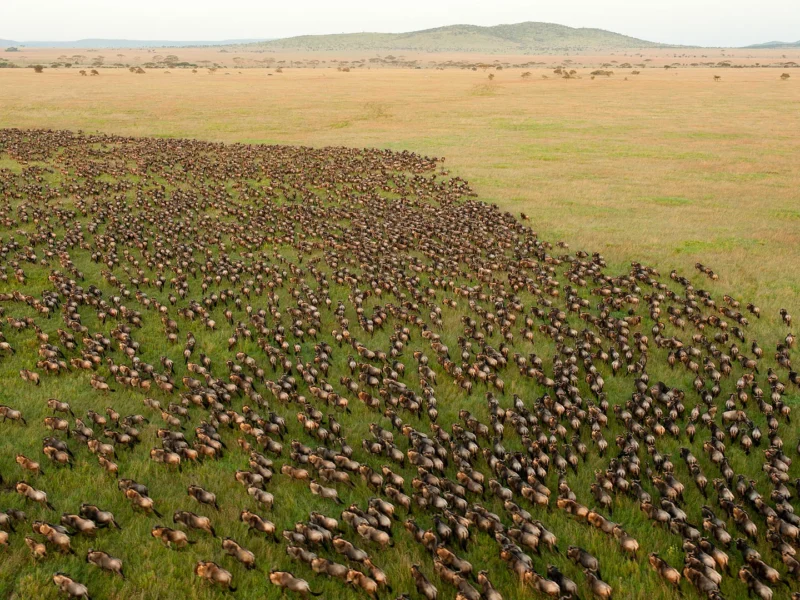
Secretary birds often share the plains with the calving herds, cheetahs and ostriches, so a morning drive can bring several species.
Other plains birds
The Serengeti plains are rich in birds that live on the ground:
- Common ostrich, the world’s largest bird.
- Kori bustard, one of the heaviest flying birds.
- Southern ground hornbill, in family groups.
- Grey crowned crane in wetter areas.
- Rufous-tailed weaver and grey-breasted spurfowl, two Tanzanian endemics.
A good guide will help you find many of these on a morning drive, and the Serengeti’s open grasslands make them easier to see than in forest.
Breeding
Secretary birds build large, flat nests on top of thorny acacias. They lay two to three eggs, and both parents feed the chicks, which stay in the nest for up to three months.
Where to stay
In the Serengeti, stay in the central Seronera area or near the southern plains, where secretary birds are common.
Photography tips
Secretary birds walk steadily, so you can follow them with a long lens. Capture them with prey or in flight, showing their long tail feathers.
Other places to see them
Secretary birds also live in the Masai Mara, Amboseli, Kidepo Valley in Uganda and Akagera in Rwanda.
Who it suits
Birders, photographers and families who love unusual animals.
Hunting in detail
Secretary birds walk up to 20 to 30 km a day through the grass, flushing prey with their feet and wings. When they find a snake, they stamp on it repeatedly, keeping their legs out of reach behind the snake’s head. Their legs are protected by thick scales, and their long legs keep their bodies away from bites. They also eat grasshoppers, beetles, rodents, lizards and small birds. Researchers have measured kicks that strike in about 15 milliseconds, faster than the blink of an eye, showing why they are such effective predators.
When to go
Secretary birds can be seen year-round in the Serengeti. In the green season, from about November to May, short grass and abundant insects and rodents make them easy to spot on the southern and central plains.
Plan it
See them on our 4-day Serengeti and Ngorongoro safari or 7-day Tanzania northern circuit safari.
Frequently asked questions
Why is it called the secretary bird?
Its crest is said to resemble quill pens behind a secretary’s ear.
Does it really kill snakes?
Yes, by stamping and kicking them.
Is it endangered?
Yes, since 2020.
Can it fly?
Yes, well, though it usually hunts on foot.
How fast can a secretary bird kick?
Studies show a kick lasts only a fraction of a second, delivering a force several times the bird’s body weight.
Are secretary birds easy to see?
In the Serengeti, they are seen regularly on the open plains, often walking in pairs.
Do secretary birds fly?
Yes. They fly well and roost in trees, though they hunt on foot.
Where else can I see them?
The Masai Mara, Amboseli, Kidepo and Akagera.

Written by our Kampala-based planners and guides, who arrange these trips every season. Prices and rules are checked before every quote.