To photograph gorillas and chimps, use a camera that handles low light, a mid-range zoom (24–105 mm or 70–200 mm) for gorillas and a longer lens for chimps, shoot at wide apertures with ISO 1600–6400, keep shutter speeds above 1/250 s, expose for faces, and never use flash. Take time to watch without the camera too.
Key takeaways
- No flash: it is not allowed with primates.
- Forest light is dim: use high ISO and wide apertures.
- Expose for the faces, not the background.
- Gorillas are close: a mid-range zoom is ideal.
- Spend some of the hour just watching.
Gorillas and chimpanzees live in dense forest, where light is dim, contrast is high and your subjects are dark-furred and often partly hidden by leaves. It is challenging, but with the right approach you can capture extraordinary portraits and moments.
Know the rules
- No flash, ever.
- Keep at least 10 metres away, unless the primates approach you.
- One hour with the group, and rangers decide where you stand.
- No eating or drinking near the apes.
Camera settings
| Setting | Suggestion |
|---|---|
| Mode | Aperture priority or manual with auto ISO |
| Aperture | Wide (f/2.8–f/5.6) |
| Shutter speed | 1/250 s or faster (faster for chimps) |
| ISO | 1600–6400, higher if needed |
| Focus | Continuous AF on the eye |
| Metering | Spot or centre-weighted on the face |
Lenses
- Gorillas: often within a few metres, so a mid-range zoom (24–105 mm or 70–200 mm) works best; a wide lens captures them in their habitat.
- Chimps: often higher in trees and moving fast, so a longer zoom (100–400 mm) helps.
- Avoid changing lenses in the forest; two bodies or one versatile zoom is ideal.
Exposure and composition
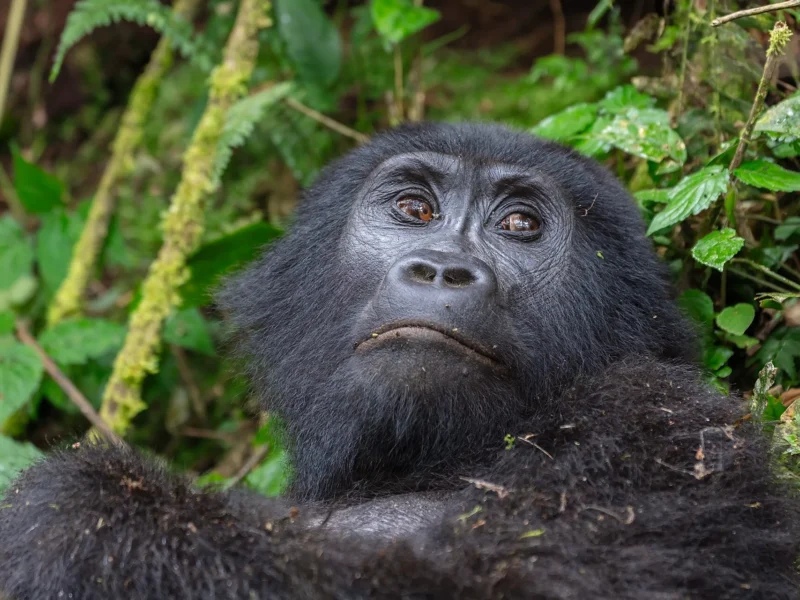
- Expose for the face. Dark fur fools meters into overexposing. Spot-meter on the face or dial in negative exposure compensation.
- Focus on the eyes. Sharp eyes make a portrait.
- Look for gaps in the vegetation; a small step can clear a branch from the face.
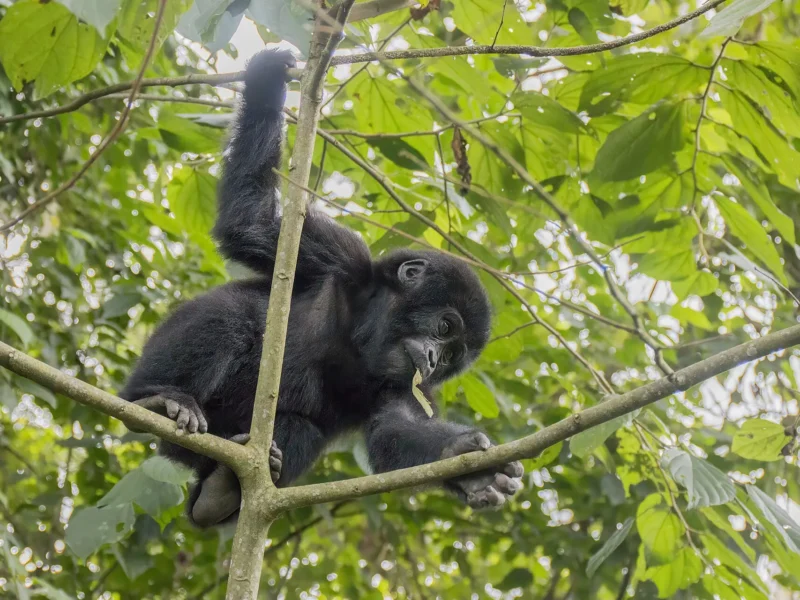
- Include context: infants with mothers, a silverback with the forest behind, hands, feet and expressions.
- Wait for behaviour: grooming, feeding, play and interaction tell stories.
Phones
Modern phones take excellent photos in forest light. Turn off flash, use the main lens rather than digital zoom, tap to focus on the face and hold steady. Portrait mode can work well on a close gorilla.
Set your camera before the hour starts. Once you are with the gorillas, you won’t want to fiddle with menus.
Protecting your gear
Forest treks are wet and muddy. Use a rain cover, carry spare batteries and cards in a dry bag, and wipe your lens often. A porter can carry your bag so your hands are free.
More time, better photos
For photographers, more time makes a big difference. Consider a second gorilla trek on our 5-day double gorilla trekking safari, or up to four hours with a family on the gorilla habituation experience. Read our photographers’ travel guide and what to pack for gorilla trekking.
Put the camera down
Finally, spend part of the hour simply watching. The memory of a gorilla looking calmly back at you, without a viewfinder in between, is one you will never lose.
Common mistakes to avoid
- Overexposed faces: dark fur and bright backgrounds confuse meters; check your screen and adjust.
- Shutter too slow: chimps move quickly; raise ISO rather than slowing the shutter.
- Only shooting faces: hands, feet, infants and interactions add variety and emotion.
- Forgetting video: a short clip of a silverback feeding or chimps calling captures what stills cannot.
- Shooting the whole hour: take time to simply watch and remember.
Editing tips
Back at the lodge, lift shadows carefully to reveal detail in dark fur, reduce highlights in bright backgrounds, apply noise reduction to high-ISO images and keep colours natural. Avoid heavy filters: the forest’s greens and the animals’ expressions are beautiful as they are.
Frequently asked questions
Can I use a phone?
Yes. Modern phones handle low light well. Use night or portrait modes carefully and hold the phone steady.
Is flash allowed?
No. Flash is prohibited with gorillas and chimpanzees.
Can I use a tripod?
Tripods are impractical in dense forest. A monopod or your walking stick can help steady the camera.
What about video?
Video is allowed. Keep clips short and steady, and remember sound: the gorillas’ grunts and chimps’ calls make wonderful recordings.
How do I keep gear dry?
Use a rain cover or a plastic bag and carry silica gel packs in your bag.
Which camera is best for gorillas?
Any modern camera with good low-light performance. Full-frame or recent APS-C bodies with a fast zoom are ideal.

Written by our Kampala-based planners and guides, who arrange these trips every season. Prices and rules are checked before every quote.